How Rainfall Distribution Affects Tobacco Leaf Maturity, Thickness, and Downstream Fermentation Parameters
After the Storm in the Field: A Contest Over Physiological Rhythm
In mid-July 2022, weather forecasts for the central Yunnan tobacco-growing region predicted several consecutive days of heavy rainfall. As a technician who has worked in tobacco fields for twenty years, I felt unusually heavy-hearted at the time. The fields were at a critical point of the maturity stage — the golden period when leaves accumulate dry matter, complete pigment transformation, and settle their final “identity” (leaf thickness and tissue density).
The rain was even more violent than expected. Three consecutive days of heavy precipitation left even well-drained tobacco areas with large areas of standing water. I stood at the edge of the field ridges, watching those once lush, thick leaves look somewhat helpless under the storm's battering. Rainwater is not just water; it also carries a violent disturbance to the crop's physiological metabolism.
Many newcomers assume that more rain simply means ample water, which is a good thing. But in tobacco cultivation, the “distribution” of rainfall matters far more than the “total amount”. An imbalanced water supply directly decides whether this batch of leaves will become an “aroma carrier” in the downstream fermentation stage or turn into a “source of off-flavors”.
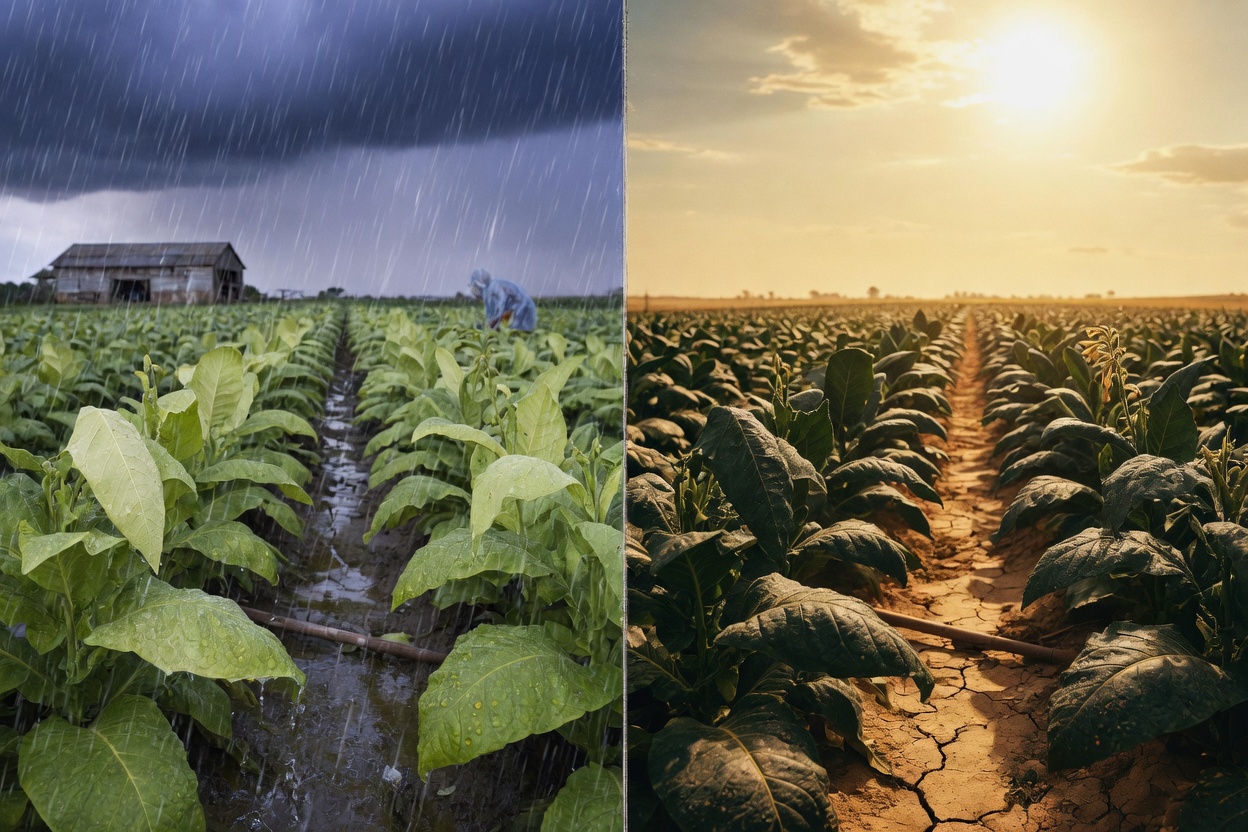
How Rainfall Reshapes the Physiological Traits of Tobacco Leaves
Excessive Rainfall: The Trap of False Ripening and a Missing Identity
When excessive rainfall hits during maturity, the physiological rhythm of tobacco is thrown into complete disorder. The first issue is the “leaching effect” of nutrients. Large amounts of rainwater infiltrate and quickly carry away key elements such as nitrogen and potassium from the soil surface — especially nitrate nitrogen, which is lost extremely quickly. For the plant, this is not merely hunger; it is a kind of metabolic chaos.
The most dangerous phenomenon is “false ripening”. In rainy conditions accompanied by low temperatures, the chlorophyll degradation process in leaves becomes abnormal. Instead of accumulating sugars and volatile compounds through slow physiological senescence, the leaves are forced into a “stress-induced yellowing” because of root hypoxia and interrupted nutrient supply. Such leaves look yellow, yet their internal content is extremely hollow.
From a physical perspective, excessive rainfall often makes the “identity” of tobacco leaves thinner. Because of the oversupply of water, cells expand excessively, but the accumulation of dry matter (such as cellulose and lignin) cannot keep pace, leaving the leaf tissue loose. Such thin leaves look light at harvest, but during subsequent curing and fermentation, the incomplete cell-wall structure makes aroma compounds evaporate too quickly at high temperatures, and even a “burnt smell” can appear.
Insufficient Rainfall: Tissue Coarsening Under Drought Stress
Conversely, if rainfall is severely insufficient during critical periods, the situation swings to the other extreme. Drought stress forces tobacco to close its stomata to reduce transpiration, which directly suppresses photosynthesis.
In such an environment, leaves show obvious “tissue coarsening”. To survive, the plant increases cell-wall thickness to strengthen drought resistance, which macroscopically appears as leaves becoming abnormally thick and stiff, with a dark green or even black color. Although such “thick-identity” leaves look textured, their internal osmotic regulation is out of balance, causing the sugar-to-alkaloid ratio (the ratio of sugars to alkaloids) to shift abnormally — often too alkaline in taste and lacking delicate sweetness.
Technical Responses: From Field Management to Precise Regulation
Faced with the uncertainty of rainfall distribution, we cannot sit idle; we must hedge the risk through refined technical intervention.
Flood Response: Drainage, Nitrogen Control, and “Half Film Lifting”
In the rainy season, the top priority is to “protect the roots”. Our strategy is to build an efficient field drainage network to ensure that standing water drains away within hours, preventing roots from being oxygen-deprived for long periods.
Regarding fertilizer and water management, my personal experience is: better to be deficient than excessive; advance steadily. During frequent rainfall periods, the use of high-nitrogen fertilizer must be strictly controlled. Excessive nitrogen fertilizer in rainy conditions easily causes leggy growth and false ripening. I would suggest increasing the proportion of potassium fertilizer and micronutrients (such as calcium and magnesium), using potassium to strengthen cell walls and enhance the stress resistance of leaves, thereby somewhat rescuing the problem of thinning “identity”.
In addition, in some finely managed tobacco areas, we adopt the “half film lifting” technique to regulate soil temperature and moisture through physical means, mitigating the impact of rainfall on the soil microenvironment.
Drought Response: Precision Irrigation and a Moisture Buffer
For drought risk, we no longer rely on traditional flood irrigation but have fully shifted to precision drip irrigation. The key is “small amounts, frequently”. By establishing a stable soil moisture buffer zone, we avoid violent wet-dry alternation for the plants, thereby preventing tissue damage caused by rapid cell shrinkage. At the same time, combined with mulching techniques (such as straw mulching), surface evaporation is minimized.
Bridging to the Factory: Fermentation Parameter Adjustments Based on Quality Traits
Rainfall problems in the field eventually “reveal themselves” in the fermentation workshop. As technicians, we must build a mapping logic from “field climate” to “fermentation parameters”.
Strategy for “Thin, Wet, Falsely Ripe” Leaves
For leaves produced in rainy seasons, with thinner identity and relatively high moisture content, the core fermentation logic is: temperature control first, dehumidification first.
The chemical composition of such leaves is often uncoordinated, and protein and starch residues may be relatively high. If conventional high-temperature fermentation is used, intense ammonia release and mold are easily triggered. My approach is:
- Lower the initial temperature: control the early fermentation temperature at a relatively low level, giving enzymatic reactions a gentler timeline and avoiding aroma loss caused by overly fast reactions.
- Strengthen ventilation and dehumidification: during fermentation, the air circulation frequency must be increased to promptly remove excess moisture and volatile off-gases.
- Extend the fermentation cycle: because the stability of its internal substances is poor, a longer timeline is needed to bring the chemical composition to relative balance.
Strategy for “Thick, Hard, Highly Alkaline” Leaves
For leaves produced under drought conditions, with thick tissue and a strong alkaline taste, the challenge lies in “penetration” and “reducing irritation”.
Because the cell walls are thick and the tissue is compact, heat and moisture transfer slowly. Our strategy is:
- Raise the initial humidity: in the early fermentation stage, increase environmental humidity so that moisture can penetrate more effectively into the thick leaf tissue.
- Staged temperature-shift process: use stepped temperature control — first, moderate temperatures promote enzymatic hydrolysis, converting substances in the hard tissue into usable aroma precursors; then, an appropriate temperature increase accelerates the Maillard reaction, enhancing color and body.
- Precisely monitor the core temperature: thick leaves are prone to the condition of “hot outside, cold inside”; the core temperature of the tobacco pile must be monitored in real time to prevent residues of irritating substances caused by incomplete internal reactions.
Conclusion: A Closed Loop of Ecology and Process
Changes in rainfall distribution are, in essence, a powerful interference by natural ecology with the physiological rhythm of crops. As a link in the tobacco industry, we cannot try to change the weather, but through deep physiological understanding, we can correct the growth direction in the field through “technical hedging” and offset quality fluctuations in the factory through “parameter compensation”.
Only by tightly coupling field rainfall data, the identity traits of leaves, and the temperature-humidity curves in the fermentation pile can we truly achieve the leap from “depending on the weather” to “precise regulation”. This is not only technological progress but also reverence for and adaptation to the laws of nature.
Leaching effect: heavy rainfall quickly carries away surface nitrogen, potassium and other nutrients, triggering metabolic chaos.
False ripening: under rainy, low-temperature conditions chlorophyll degradation becomes abnormal; leaves look yellow but are hollow inside.
Half film lifting: physically regulating soil temperature and moisture to buffer the impact of rainfall on the soil microenvironment.
Hot outside, cold inside: the core of a thick leaf pile stays cooler, so incomplete internal reactions may leave irritating residues.