The Complete Manufacturing Process of Cigarettes — From Tobacco Leaves to Rolling, Filters, and Packaging
On a Tuesday morning shift in March 2022, I followed the production line in the primary processing workshop (制丝车间) of a cigarette factory in South China. At seven o'clock sharp, the conditioning cylinder was already turning, and the air smelled of hot, humid tobacco and a faint hint of casing solution; by 8:40, the operator beside the cutting machine was checking samples of cut leaf width; shortly after nine, the near-infrared moisture reading at the drying outlet kept pushing toward the upper edge of the target band, so the shift leader pulled the flow rate and hot-air parameters back, and the entire batch of suspect cut tobacco was isolated. That same afternoon, I moved over to the making–packing workshop: the cigarette maker drew the cut tobacco into a continuous tobacco rod, wrapped it in cigarette paper, joined on the filter rod, twisted on the tipping paper, and finished cigarettes flowed toward the packer at a rhythm of several thousand cigarettes per minute.
Many people think a cigarette is simply "rolling up a tobacco leaf." Once you have actually stood on the line, you understand: an industrial filtered cigarette is a specification project strung together from field curing, threshing and redrying, leaf blending, primary processing, making–joining, and packaging. Tobacco leaves provide the raw-material base; the factory provides a repeatable physical form and sensory window. Below, following the real main flow, I will write clearly how this cigarette is made.
1. The Big Picture First: a Seven-Stage Main Chain, Not "Just Rolling It"
In the industry's account, modern cigarette manufacturing roughly goes through these major items:
- Initial curing of tobacco leaves (post-harvest processing in the field; China's dominant flue-cured type mainly uses curing barns)
- Threshing and redrying (separating stems from lamina, redrying, baling)
- Aging / warehouse coordination (letting green, raw notes and harshness move toward a blendable direction)
- Leaf blending and preparation
- Primary processing (conditioning, casing, cutting, drying, blending, flavoring, storing)
- Cigarette making + filter attachment
- Carton / pack / case packaging and pre-shipment inspection
In between there are also filter rod forming, cigarette paper and tipping paper supply, adhesives, online rejection, and batch traceability. The "pack of cigarettes" you see is the result of all these systems passing at the same time; if moisture runs away, foreign matter gets in, or loose ends exceed the limit in any single link, no amount of pretty packaging later can save it.
My view: When reading a production process, do not rush to mythologize "one particular top-grade tobacco leaf." The core capability of industrial cigarettes is: within ton-level raw material fluctuations, to make a cigarette that is stable enough in consumer perception. Stability depends on blending and primary processing; aroma depends on the raw-material base plus the casing/flavoring system; form depends on making–joining and packaging.
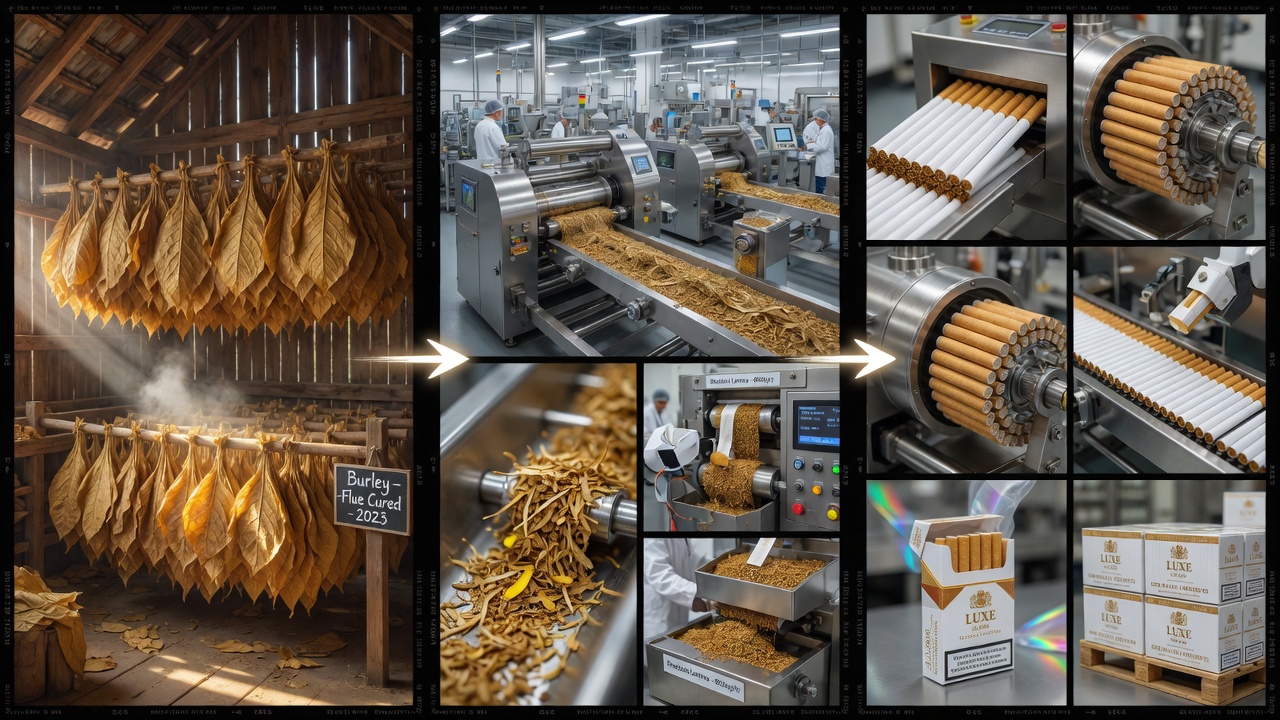
2. After the Field: Initial Curing — Turning Fresh Leaves into Storable Raw Tobacco
2.1 Harvesting Is Not the Endpoint
Flue-cured tobacco is usually harvested in batches by stalk position and maturity. Fresh leaves have high moisture content and vigorous enzyme activity; if not cured they will rot, stay green, and lose industrial usability. In China's main producing areas (Yunnan, Guizhou, Henan, Fujian, etc.), since bulk curing barns became widespread, curing has shifted more from "master-watched old-style barns" to "curve plus inspection rounds."
2.2 What Initial Curing Does
It is enough to simplify it into three-stage logic:
| Stage | Main purpose | On-site intuition |
|---|---|---|
| Yellowing | Chlorophyll degrades; appearance turns from green to yellow; internal substances begin to transform | Leaf color and vein color are the first indicators |
| Leaf-drying (color fixing) | Fixes the yellow, suppresses improper browning and off-color change | If the heating and dehumidification rhythm goes wrong, the leaf easily becomes gray-spotted or burnt black |
| Stem-drying | Main vein fully dries for storage and transport | If the stem is not dry, the risk of later mold and moisture regain rises sharply |
A full barn cycle in the producing areas is commonly on the order of about 5–8 days (fluctuating with leaf condition, loading density, and barn type). After initial curing, the leaf becomes "raw tobacco" and enters the purchasing, grading, and allocation system.
2.3 Common Failures in Initial Curing
In September 2019, I helped unload tobacco at a cluster of curing barns in southern Guizhou. In one barn, because dehumidification was slow during the leaf-drying stage, the middle layers showed obvious gray spots and local burnt black. The farmer grieved over the grade price difference; for the factory, such leaf could only be downgraded or rejected — once initial curing fails, no matter how clever the later blending, the original color of that batch cannot be recovered.
Air-cured and sun-cured paths differ (natural air drying/sun drying, often longer cycles), but in industrial cigarette blending they are mostly "functional leaves" or special leaf groups, while the main skeleton is still usually flue-cured threshed lamina. This article follows the main line of flue-cured industrial cigarettes.
3. Threshing and Redrying: Breaking "Whole Leaves" into Measurable Industrial Material
3.1 Why Threshing Is Necessary
Whole leaves carry stems. The lamina (threshed leaf) and the stem differ in burning, filling, and processing characteristics: mixed together into primary processing, both cutting quality and burn stability become hard to control. The task of threshing is to separate lamina and stem, then redry and bale them separately.
The logic of international and domestic threshing/redrying plants (GLT / redrying plants) is similar:
- Opening bales, removing foreign matter, conditioning (making the leaf pliable to reduce breakage)
- Threshing + air classification (multiple threshing passes, multi-stage separation, separating stems and lamina)
- Redrying lamina, redrying stems
- Cooling, conditioning back to target moisture, baling into cases
The processing capacity of many threshing lines worldwide is measured on the order of several to more than ten tons per hour; large domestic lines commonly process tens of tons per day — depending on line configuration. After redrying, lamina moisture in the industry is commonly controlled in a window of about 11%–13%, convenient for warehousing and later conditioning.
3.2 Redrying Is Not as Romantic as "Making It Smell Better by Roasting Again"
The engineering purpose of redrying is colder:
- Unify moisture and inhibit mold;
- Moderately deactivate enzymes and unstable components;
- Improve the consistency of raw-material specifications, convenient for cross-province transport and blend weighing.
In November 2021, I watched a threshing/redrying plant near Yuxi, Yunnan for nearly two hours from the observation walkway. The conveyor rhythm was steady, and the impurity-removal ports occasionally spat out mulch film fragments and bits of rope. An inspector said what they feared most was not "whether it smells good," but foreign matter and moisture batch drift — aroma problems can be offset in the blend, but metal wire and plastic entering the cigarette maker is an accident.
3.3 Aging: After Redrying, Time Is Also a Process Step
Freshly redried lamina, if taken directly to make a high-grade leaf blend, often has a more pungent green, raw note and harshness. In industry practice, lamina/raw tobacco enters aging warehouses or long-term storage, letting chemistry and sensory move toward "rollable, blendable." In popular science and industry accounts, aging times on the order of several months to several years are all common (grade, use, and storage conditions differ; there is no one-size-fits-all).
My view: The "mellowness" consumers taste is largely not advertising copy, but the stack of storage time + later casing/flavoring in primary processing + leaf-blend offsetting. Understanding aging as "letting it rot" is amateur; understanding aging as "automatically becoming premium" is also amateur — if not managed well, aging warehouses can just as easily produce mold, sourness, and insects.
4. Blending: A Cigarette Is "Rolled" in a Spreadsheet Before It Enters the Workshop
What a cigarette factory holds is multi-origin, multi-grade, multi-year lamina, stems, expanded tobacco, reconstituted tobacco, and other modules. The task of blending is:
- Under cost and inventory constraints, assemble the target tar/nicotine design window and sensory profile;
- Guarantee substitutability: when one grade is out of stock, a contingency leaf can fill in so the whole line does not stop;
- Give primary processing clear leaf-group proportions, casing/flavoring plans, and blending ratios.
Blending meetings are not romantic. The discussions I sat in on had keywords like: filling value, burn rate, harshness, off-notes, aftertaste, cost per ton, inventory age. Sensory evaluation has reference samples and chemistry has routine indicators, but in the end you still answer an engineering question: tomorrow when we feed the line, can the machine stay steady, can the mouth stay steady.
5. Primary Processing: Turning Lamina into "Cut Tobacco a Cigarette Maker Can Eat"
Primary processing is the mid-chain heart of industrial cigarettes' flavor and physical quality. Taking the lamina process as the main line, the common chain is:
Preparation → Conditioning → (Casing) → Leaf storage → Cutting → Drying → Blending with stem/expanded cut tobacco → Flavoring → Cut-tobacco storage → Delivery to making–packing
5.1 Conditioning and Casing
Out-of-warehouse lamina has low moisture and is brittle; cutting it directly would shatter it into dust, and both filling value and whole-cut rate would collapse. Conditioning pulls leaf temperature and moisture into the processable zone. Casing is mostly done at the leaf stage: casing solution improves taste, pliability, and processability — it is not as simple as pouring supermarket flavor essence on top, but is applied by measured weight ratio according to the formula, then leaf storage lets the solution penetrate evenly.
Leaf storage time is commonly on the hour scale, aiming to equalize moisture and casing solution and reduce "wet outside, dry inside" during cutting.
5.2 Cutting
Leaf lamina is cut into leaf cut tobacco; stems often go: conditioning → stem flattening → cutting into stem cut tobacco (some also have stem expansion).
Common industry magnitude:
- Cut leaf width is commonly in the 0.6–1.0 mm range;
- Stem cut tobacco is finer, e.g. on the 0.15–0.3 mm order is often mentioned;
- Flattened stem thickness is mostly in a window of about 0.7–1.2 mm; if not flattened through or crushed too much, the risks of poor filling and piercing the cigarette paper both rise.
The cutter (drum-knife type, etc.) needs stable width and little breakage. Cut tobacco too broken: loose ends in making, end loss, erratic draw resistance; cut tobacco too wide: burning and appearance bring another set of problems.
5.3 Drying: Moisture Content Is the Lifeline
Drying dries the wet cut tobacco after cutting to a moisture suitable for making and storage, while also affecting filling value and aroma retention. Too wet: sticky, hard to make, easy to mold; too dry: brittle, breaks into dust, aroma flies off, burns too fast. In the literature and process discussions, cut-tobacco moisture entering making is commonly placed in a control band around about 12% (e.g. expressions like 11.5%–12.5%), with specific brand sizes per the factory's process card.
On that morning shift in 2022, when the moisture at the drying outlet pushed to the upper edge, what I saw was not "just 0.5 percentage points off," but the whole logic chain raising the alarm:
- Filling and flowability change;
- The making weight center may drift;
- Whether the storage room should even accept this batch.
The crew spent about 40 minutes adjusting parameters, isolating, and re-inspecting. The cruelty of industrial primary processing: you almost never have the right to say "good enough," because downstream the maker amplifies your error by several thousand cigarettes per minute.
5.4 Blending, Flavoring, and Storing Cut Tobacco
Leaf cut tobacco, stem cut tobacco, expanded cut tobacco, and reconstituted tobacco cut tobacco are mixed by ratio and enter the flavoring drum. Flavoring is more about aroma finishing and product recognition; casing is more about taste and processability — the two are at different stages, so do not lump them together and curse "it's all essence."
The purpose of cut-tobacco storage is:
- Let flavoring and moisture re-equilibrate;
- Give the making–packing workshop a stable buffer inventory;
- On brand changes or breakdowns, keep the upstream from stopping dead immediately.
My view: Outsiders always ask "what is added to the cut tobacco." The better question is: in the industrial system, casing and flavoring are the means of locking multi-origin raw-material fluctuations inside a sensory-spec cage. You may dislike this system, but denying its engineering function means you cannot understand why modern cigarettes taste the same across the whole country.
6. Making and Filters: Turning Cut Tobacco into "Sticks"
6.1 How the Tobacco Rod Is Formed
The mainstream modern logic is the suction-rod cigarette maker:
- Cut tobacco is air-selected, with overly heavy stem bits and overly fine dust removed (different machine configurations differ);
- A continuous, density-controlled cut-tobacco strand forms on the suction band;
- Cigarette paper (wrapping paper) unwinds, is gummed, and wraps into a continuous tobacco rod;
- It is cut into cigarette units (non-filter or waiting for filter attachment).
Philip Morris and other public science material also describes an efficient attachment idea: first form an extra-long tobacco rod, attach filters at both ends, then cut it in the middle, getting two cigarettes at once — the principle in all cases is continuous rod forming + precise cutting + filter joining.
Machine speeds span a wide range: low speed roughly below 1,200 cigarettes/min, medium speed about 2,000–2,500 cigarettes/min, high speed above 4,000 cigarettes/min, and even higher platforms are announced internationally. The faster the machine, the more demanding the requirements on cut-tobacco structure, paper strength, glue, and filter rod straightness.
6.2 The Filter Is Not "Stuffing a Ball of Cotton"
Filter rods are mostly made on dedicated filter rod-forming machines:
- Acetate tow is opened and fluffed;
- A plasticizer such as triacetin is applied so the tow bonds into a resilient rod;
- It is wrapped with plug wrap and cut into filter rods;
- The rods are delivered to the making–joining unit.
At attachment, the filter rod is aligned with the cigarette and joined with tipping paper. The tipping paper can have laser perforation etc., used to adjust ventilation rate, thereby affecting draw resistance and smoke dilution — this is a product design parameter, not magic that "filters out everything harmful."
6.3 The Usual Quality Battleground in Making–Joining
Making and joining directly determine:
- Cigarette weight, circumference, length, hardness;
- Draw resistance, ventilation;
- Loose ends, end loss;
- Open seams, curled edges, blistering wrinkles, off-center filters.
Online inspection watches weight, loose ends, appearance, etc., and rejects unqualified sticks directly. In May 2023, I watched a "loose-end tide" beside a making–packing line in East China: in the previous hour the rejection rate had crept up, and the machine technician found it was the combination of needle roller/brush and cut-tobacco whole-cut rate state, with feeding uniformity degrading. Stopping the machine to replace parts and adjust parameters cost not only output but also the shift's planned brand-switch window — the making–packing workshop's timetable is interlocked by order.
My view: The filter changes the way smoke is delivered and partially the particulate-phase retention characteristics. It absolutely does not turn a cigarette into a safe consumer product. Writing this clearly in process terms is to oppose two extremes: one is "filters are useless, pure deception," the other is "with a filter, you can smoke with peace of mind." Both are lazy.
7. Packaging: Moisture Protection, Counting, Brand Face, and Final Discipline
7.1 The Pack Is the First Layer of Industrial Goods a Consumer Truly Touches
Once cigarette moisture is acceptable (process usually requires on the order of 11.5%–12.5%; too high often means baking first), it enters packaging:
- Inner liner (the traditional aluminum foil or composite lining paper) — part of moisture protection, aroma preservation, light blocking;
- Pack forming, printed face, and tear tape;
- Transparent film (cellophane) heat sealing;
- Carton (commonly ten packs) → case packing.
Between the packer and the maker there is often overhead conveying and buffering (the industry often mentions spiral overhead conveyors and similar devices) to absorb the rhythm difference between the two sides. Pack types are numerous (hard pack, soft pack, etc.), and machine models are picky about material thickness, stiffness, and glue-line position.
7.2 Packaging Quality Is Not Just "Looking Nice"
The real consequences of a packaging failure:
- Poor sealing → cigarettes run wet or too dry, and both taste and burning change;
- Missing cigarettes, upside-down cigarettes → direct customer complaints;
- Wrinkled film, weak heat seals → both shelf image and anti-counterfeit perception suffer;
- Wrong brand in carton, printing/coding errors → traceability and compliance problems.
The packaging section looks like "just boxing," but it is actually the final gate that locks all the quality results of preceding processes into a marketable commodity form.
7.3 Inspection and Batches
Modern plants commonly have in-process inspection plus finished-product inspection: physical indicators, appearance, packaging seal, and when necessary smoke and sensory release. MES/batch management hangs "which day, which line, which leaf group" on the case code — when a problem occurs, you must be able to trace it back, not rely on memory.
8. Stringing the Process into an "Everyday-Language Timeline"
Assuming logistics waiting is ignored and only the process logic order is discussed:
| Stage | What you get | Key controls |
|---|---|---|
| Initial curing | Raw tobacco | Yellowing/leaf-drying/stem-drying; prevent gray spots and burnt black |
| Threshing and redrying | Lamina cases, stems | Stem–lamina separation, foreign matter, moisture on the order of about 11%–13% |
| Aging storage | Blend-ready material | Time, temperature/humidity, prevent mold and insects |
| Blending preparation | Leaf group plan | Ratios, cost, substitutability |
| Primary processing | Qualified cut tobacco | Cut width, drying moisture, casing/flavoring uniformity, filling |
| Making–joining | Filtered cigarettes | Weight, loose ends, draw resistance, attachment quality |
| Packaging | Pack/carton/case | Seal, counting, coding, appearance |
The field grows for a year, the curing barn burns for about a week, the redrying plant runs continuous shifts, the aging warehouse holds for a long time, the primary processing workshop spits out cut tobacco by the hour, and the maker spits out several thousand cigarettes per minute — the time scale is compressed by industry into the latter half, but risk can lay a mine in every stage.
9. Two Field Scenes: the Friction You Do Not See in the Process Book
9.1 Foreign Matter at the Redrying Plant and "Almost Getting into the Case"
During that 2021 visit, the impurity-removal ports continuously ejected woven-bag filaments. If the farmers' delivery and bale-opening checks upstream were lax, foreign matter could ride all the way into the lamina. The factory relies on multi-stage impurity removal and manual sorting as a safety net, but even the best system fears occasional metal and hard debris. My judgment at the time was simple: the first morality of the tobacco industry is not aroma poetry; it is never let consumers smoke something that should not be there.
9.2 The Chain Reaction of Primary Processing Moisture and Making Loose Ends
In that March 2022 moisture-over-the-edge event, if the batch had been released rashly:
- Cut tobacco slightly sticky → suction strand forming unstable;
- Weight center drifting → draw resistance and burning drift along;
- End loss and loose-end rejection rate rising → the packaging section waits for rice (material).
The shift leader chose isolation instead of gambling. I think that is the foundation of industrial people: output can be made up, but feeding uncertain cut tobacco into a market at the million-stick level cannot be made up.
10. Personal Judgment: after Reading the Process, What Conclusion Should Be Kept
- An industrial cigarette is a "specification product," not "a medal pinned to one good leaf." Good raw material certainly matters, but without threshing/redrying, blending, primary processing, and making–joining, there is no stable modern cigarette.
- Moisture, whole-cut structure, and density uniformity decide smoking physical experience more than marketing talk does. With the same leaf group, if drying and making spin out of control, a cigarette can be smoked into "blocked, empty, harsh, loose."
- Filters and ventilation are product design parameters, not a get-out-of-health-free card. They change smoke delivery; they do not cancel the health risks of tobacco exposure.
- Casing and flavoring are neither the only villain in the original-sin narrative nor the only hero of flavor. They are standard equipment for large-scale consistency production; hating them is fine; pretending industrial cigarettes could unify national taste with "pure leaf, zero processing" is dishonest.
- For people who want to understand harm reduction, quitting, or alternative products, the value of this process is building a frame of reference: The problem structure of combustible cigarettes is not the same process chain as heat-not-burn, e-cigarettes, or nasal nicotine delivery. If you cannot get clear "how a cigarette is made," later comparisons easily become slogans shouting at each other.
Layman account
Imagines an industrial cigarette as "rolling up good leaf," explaining the whole cigarette with one leaf.
Engineering account
Sees it as a "specification project": curing, redrying, aging, blending, primary processing, making–joining, and packaging linked in seven stages.
11. Conclusion
From tobacco leaf to a pack of cigarettes, the path can be compressed into one sentence: curing sets the raw-material base, redrying sets the industrial form, aging sets usability, blending sets the skeleton, primary processing sets rollability and the taste window, making–joining sets the physical stick form, and packaging sets the market form.
I wrote this not to make anyone want to smoke more, nor to gold-plate the craft of any brand. It is only because, after looking at those instruments, the rejection bins, and the isolated cut-tobacco carts in the workshop, I am even less willing to describe, with a lazy sentence like "isn't it just rolling up," a fact that is extremely precise and extremely frank —
A cigarette is a manufactured industrial product; each of its stabilities comes from suppressing fluctuation; each of its flavor narratives stands on this chain of suppression. Understanding the process is to pull the discussion back to materials, parameters, and risk, rather than stopping in the illusion left behind after the smoke disperses.