The Basic Principles of Cigar Leaf Fermentation — The Roles of Microorganisms, Temperature, Humidity and Time
Chapter guide: fermentation truly rewrites "the step after curing" — the four coupled factors of microorganisms, temperature, humidity and time together decide the direction of flavor.
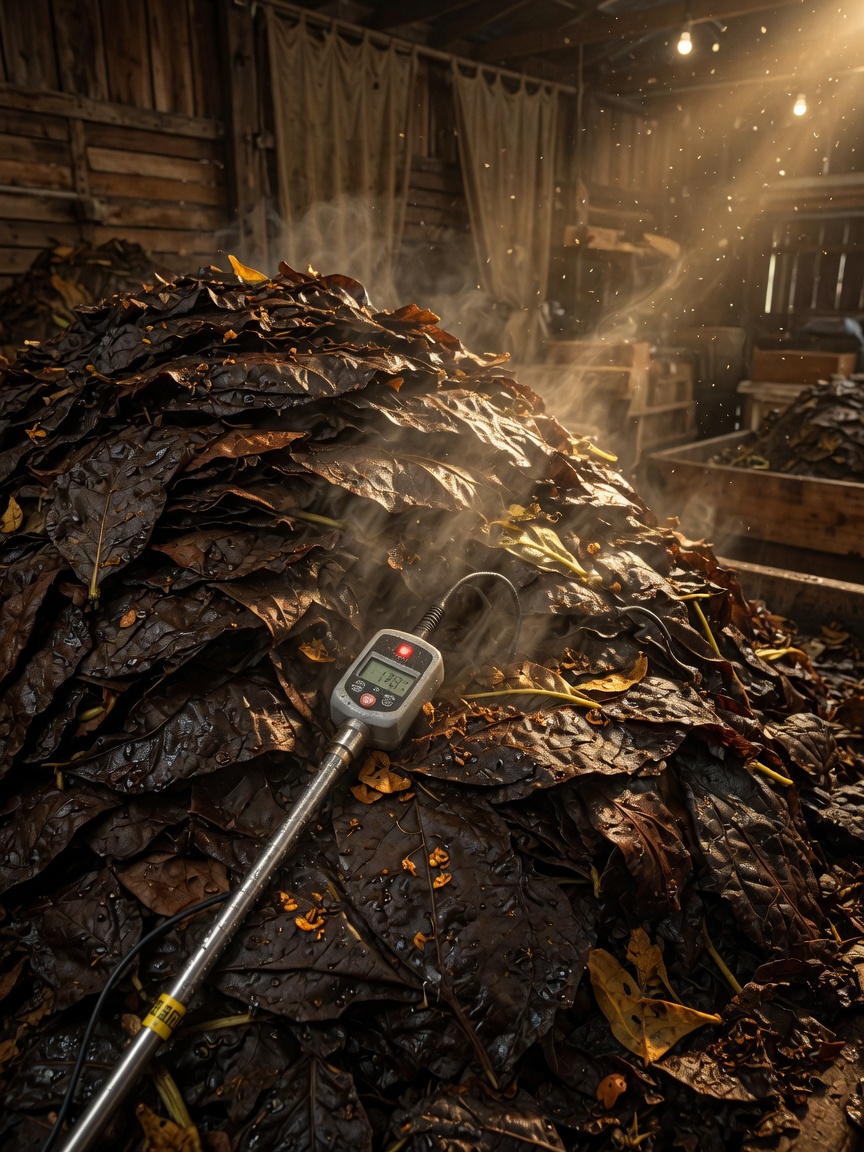
The first time I truly realized that "fermentation can change flavor" was not in a tasting class, but in a tobacco leaf warehouse at around 28℃ where the air was as damp as the plum rain season. It was August 2021, at a pilot site for cigar raw materials in Yunnan. Workers had just opened up a pile of middle leaves about 1.2 meters high and turned it over. When the core temperature probe was pulled out, the needle was still hovering near 46℃. The steam-like heat carried an ammonia smell that hit the nose first, followed by a sweet-sour note like wet wood and fermented fruit. The leaves beside them, just sorted and only cured but not yet piled, smelled completely different: dry hay, green and raw, with a bit of earth and mild irritation.
Same variety, same position, same curing batch — one round of pile fermentation (pilón / bulk fermentation) apart, and they smelled like different materials. Later I repeated this comparison many times: smell the leaf pile, then the unfermented control, then smoke a small test roll. The conclusion is firm — fermentation is not the mysticism of "it smells better if you leave it longer"; rather, with moisture as the precondition, microbial metabolic heat, enzymatic catalysis and non-enzymatic chemistry together rewrite the chemical spectrum of the leaf. Off-notes decline, ammonia irritation first appears and then subsides, sugars and proteins are broken down, volatile small molecules are reshuffled — only then does combustion and taste move from "raw" to "usable".
This article covers only one thing: how microorganisms, temperature, humidity and time constrain one another, and how they rewrite flavor together. Craftsmanship explains flavor; it does not rewrite tobacco's health properties.
1. First, pin down the position: fermentation changes "the step after curing"
The simplified chain of cigar leaf:
Field growth and harvest
    ↓
Curing (air-curing/shade-drying etc., removing most free water, setting the basic color)
    ↓
Reordering and moisture equilibration
    ↓
Pile fermentation (may be multiple rounds) / box fermentation etc.
    ↓
Sorting and grading, packing
    ↓
Warehouse aging (slow)
    ↓
Blending and rolling → equilibrium of the finished cigar
Curing solves "whether the leaf can be stored and the color stabilized"; fermentation solves "whether the leaf can move from raw harshness to rollable, smokable, and blendable". Cigar leaf largely follows relatively mild air-curing paths, leaving enough protein, polysaccharides, polyphenols, pigments and aroma precursors in the leaf — exactly the substrate for subsequent microorganisms and enzymes. Flue-cured cigarette leaf has already been largely defined in densified curing, and the industrial side relies more on blending and casing; cigar raw materials instead put a considerable part of their quality budget into pile temperature, moisture content and turning rhythm.
I have seen the common results of skipping adequate fermentation too many times in test smoking:
- Off-notes, raw green sensation and nasal irritation tend to be heavy;
- The ammonia smell is like an unclosed toilet cleaner, prickly on swallowing;
- Uneven burn, ash black and easily falling off;
- Aroma short, scattered and sharp, almost without the "standing" layers of cocoa, nut and honey sweetness.
So my basic view is: the core goal of fermentation is not to "produce a mysterious barrel aroma", but engineering usability — reduce off-notes, promote transformation, tune color and flexibility, stabilize batches, so that the later blending has something to work with.
2. A coupled model: four knobs, not four independent switches
Think of the leaves in the pile as a miniature bioreactor:
| Factor | What it mainly governs | What breaks first when out of control |
|---|---|---|
| Microorganisms | Breaking down macromolecules, generating heat, driving the nitrogenous and volatile profiles | Mold takes over → musty smell, rancidity; or weak microbial community → no fermentation |
| Temperature | Reaction rate, microbial succession, window for non-enzymatic reactions such as Maillard | Too low "false fermentation"; too high burns the leaf, charring, aroma collapses |
| Humidity/moisture | Medium for enzyme activity, oxygen diffusion, mold boundary | Too dry no activity; too wet local anaerobiosis + mold |
| Time | Degree of conversion and aroma inflection point | Too short raw; too long aroma loss, leaf quality deteriorates |
The four are not linearly additive. Humidity gives the stage for microbial activity; microbial activity raises pile temperature; pile temperature in turn selects which microbial community survives; and time decides where you stop on the curve. Turn one knob, and the other three drift with it. This is also why "copying a temperature number" is almost useless — away from moisture content, pile size, leaf position and turning frequency, the number is just an island.
3. Microorganisms: who \"eats\" the leaf, and the heat and taste they create\n\n### 1. Where the microbes come from\n\nMicroorganisms on the surface of cigar leaf mainly come from the field, the curing environment, warehouse air and operational contact. Different growing regions and different warehouses start with different microbial communities — this is one of the reasons regional styles are \"not entirely due to variety\". In published studies, Bacillus is often reported as one of the dominant groups in artificial fermentation — it is relatively heat-tolerant and can produce many enzymes, and holds up better than some heat-sensitive yeasts after the pile temperature rises. In addition, various bacteria and fungi rise and fall at different stages; there is no \"one universal probiotic formula for the whole world\".\n\n### 2. What exactly they are doing\n\nIn language that matches the senses:\n\n1. Break down proteins and polysaccharides: large molecules become small molecules, paving the way for amino acids, organic acids and carbonyl compounds; \n2. Mobilize the nitrogen system: the irritating ammonia smell often rushes out first in mid-fermentation, then falls back in a well-controlled later stage — this is often a process smell, not \"spoilage\"; \n3. Generate heat: metabolism turns chemical energy into heat, which is why the pile core is clearly hotter than the surroundings; \n4. Indirectly change pH and the redox environment: influencing subsequent enzyme activity and the direction of non-enzymatic reactions.\n\nDomestic studies have tracked the synchronized changes of bacterial community and chemical composition in artificial fermentation of Yunnan cigar leaf: as the cycle advances, the community structure is rewritten, total sugar and reducing sugar decline, and volatile aroma-related components rise — the direction matches warehouse experience. Some literature also notes that properly introducing or screening functional microbes can speed up the process and improve aroma quality, but adding microbes industrially is a process choice; it is not \"automatically more premium\", and certainly not a health endorsement.\n\n### 3. My view\n\nDo not deify microorganisms as \"fermentation fairies\", and do not demonize them as \"dirty things\". The line between beneficial activity and mold contamination is often just moisture distribution, aeration and the temperature ceiling. In spring 2022, I saw a test pile of wrapper leaves with uneven reordering: the outer leaves felt sticky when touched, their moisture content was clearly higher than the dry central zone, and three days later gray-green spots appeared on the edges; the whole pile had to be dismantled and inspected, and the loss counted in kilograms really hurt. Same formula, same target pile temperature — but only because the workers rushed through the reordering spray without a moisture equilibration period of more than 12 hours, the microbial community slid from \"helping transform\" to \"eating your stock\".\n\n---\n\n## 4. Temperature: why the pile core gets hot, and when you should act\n\n### 1. Where the heat comes from\n\nAfter stacking, the leaves form a heat-insulating body. Residual respiration, oxidation reactions and microbial metabolism stack together, and the pile core temperature is clearly higher than the surroundings — this is the physical reality of pile fermentation, and also the temperature-humidity field feature repeatedly measured in studies on cigar pile fermentation parameters by Yunnan Agricultural University and others: the center is hot, the periphery relatively cool; the humidity field often shows the opposite trend. Fermentation intensity usually weakens gradually over time, so the early stage needs the most attention.\n\n### 2. Common ranges to watch (ranges, not magic numbers)\n\nDifferent regions, different leaf purposes, natural pile fermentation and artificial chamber fermentation — the numbers are not uniform. Quantities that commonly appear in published processes and studies include:\n\n- Ambient temperature: artificial fermentation commonly uses about 25–45°C (some trials compare constant conditions of 35 / 40 / 45°C, with cycles up to about 30 days); \n- Pile core temperature: in traditional pilón accounts, some stages stress not exceeding about 35°C for long; in accounts of second pile fermentation (large burro-type piles) it can reach about 42–50°C; in home/small-scale kiln fermentation discussions there are even practices of about 50–53°C to suppress mold — that is another logic entirely, and cannot be directly applied to the turning discipline of Cuban warehouses; \n- Risk ceiling: too low a temperature and conversion is like lukewarm water; too high carries the risk of burning the leaf, charring and \"cooking to death\" the aroma. Domestic fermentation technology reviews have also written: too low fails to achieve the effect, too high carries charring risk; agricultural stacking has explicit management requirements for the maximum core temperature.\n\nIn Cuban and Caribbean traditional accounts, the common actions are: pile core reaches the set ceiling → dismantle the pile, shake and aerate the leaves → exchange inner and outer leaves and restack. Large-pile second fermentation can last tens of days, and pile weight can reach the tonne level (public descriptions mention burro accounts at about 2000 kg); temperature monitoring uses long probes, and intervention is needed above about 42°C.\n\n### 3. What turning is really turning\n\nTurning is not a ritual; it is four things:\n\n1. Equalize temperature: overheated central leaves move to the periphery to cool, and insufficiently transformed peripheral leaves enter the center; \n2. Replenish oxygen: when oxygen in the pile is consumed, local conditions lean anaerobic and the smell runs toward putrid and sharp; \n3. Disperse moisture: local water pooling is a breeding ground for mold; \n4. Break the out-of-control curve: giving the operator a chance to recheck with nose and eyes.\n\nMy own experiential judgment is: better to turn once more than to worship \"leave it alone and let it ripen by itself\". In November 2023 I visited a small factory in the Dominican Republic; the fermentation supervisor's habit was to check the gauges almost daily in the first 7–10 days, and turn when the pile temperature approached their internal ceiling (the whiteboard on the wall said 48°C warning at the time); later he stretched it to every 2 days. He told me bluntly: \"Leaf don't forgive 50 plus for long.\" — the leaf will not forgive you for holding it at high temperature for long.\n\nComparative studies of constant-temperature and variable-temperature fermentation also suggest: different temperature paths make the microbial community and final sensory profile diverge. Chasing \"fast\" with a higher constant temperature may give a cleaner, more standardized result, but the layers are not necessarily richer than a slow variable-temperature path. Stability and complexity are often a pair of goals requiring deliberate trade-offs, not two KPIs to be maxed at once.
5. Humidity: water is the reaction medium, and also the fuse for mold
1. Leaf moisture vs environmental humidity
Do not confuse the two concepts:
- Leaf moisture content: directly decides whether the leaf is soft and pliable and whether enzymes and microorganisms can work. In published methods and process accounts, the reordering target commonly falls around 16%–25% (it varies by use; some patents describe reordering to about 16%–22% before entering a warm-humid environment for fermentation). Too dry: the pile temperature cannot rise, like a stack of cold blankets. Too wet: more free water on the leaf surface, poor oxygen diffusion, mold and spoilage bacteria take the stage.
- Environmental relative humidity: chamber fermentation commonly uses a high-humidity zone, such as about 70%–95% (wrapper-type process accounts show settings like 85%–95%). High humidity is to reduce excessive moisture loss in the leaf during fermentation, not to drench the pile into a swamp.
2. Uneven reordering = the seed of all later problems
Research on common parameters of pile fermentation states it clearly: in the early stage of fermentation, middle and upper leaves easily mold, often triggered by uneven reordering and locally excessive moisture. This matches almost word for word the reasons for the failure I saw at the pilot site.
A set of pre-actions I no longer want to omit:
- Remove clearly moldy, worm-eaten and damaged leaves;
- When adding humidity, do it in small multiple passes, not with a hose spraying directly at the leaf pile;
- Leave enough moisture equilibration time (measured in hours, commonly at least overnight, depending on leaf thickness and environment);
- Hand check: the main vein can bend, the leaf flesh is soft but not dripping, and there should be no water film between leaves.
Conditioning literature also stresses: when the ideal moisture is roughly in a range like 18%–25%, enzymes and microorganisms stand on the same starting line; too dry and reactions stall, too wet and contamination risk soars.
3. Humidity and temperature hold each other hostage
High humidity + moderate-to-high temperature = the active window for microorganisms, and also the window for mold. High temperature + properly controlled relative humidity = some people use a "above the mold comfort zone" strategy for kiln fermentation, but traditional cigar pile fermentation more often goes moderate-to-high temperature + diligent monitoring + turning, rather than endlessly raising the temperature.
My clear position: the priority of humidity management often outranks your obsession with a certain target pile temperature number. If the temperature is off a little, a couple more days can make it up; if you drench the water, three days can ruin a whole pile.
6. Time: aroma has an inflection point, it is not "the longer the more expensive"
1. "Rise first, then fall" is closer to the facts than "the longer the better"
During fermentation, carbohydrates and nitrogen-containing macromolecules generally decline, polyphenols etc. also oxidize and degrade, while aroma precursors and some volatile components rise — but the total amount of aroma substances does not accumulate monotonically over time. In published reviews and experimental observations, the common expression is that aroma-related components first rise and then fall:
- In wrapper pile fermentation, observations place a high value of aroma content at about 14–21 days;
- In artificial fermentation there are accounts of an inflection point around 25 days;
- The peak days of carotenoid degradation products, cembranoid degradation products and some Maillard products differ (for example, some studies report carotenoid degradation products around day 15, cembranoids around day 25 or so).
The practical meaning: stop too early, and off-notes and ammonia still dominate; stop too late, and the sweetness and roasted notes you pursue may already have slid past their peak, and the leaf may also become brittle and thin.
The time scale also differs by form:
| Form | Time scale (common public accounts) | Characteristics |
|---|---|---|
| First-round pile fermentation | Several days to about 30 days | Sets the tone, removes rawness |
| Second large pile/box etc. | Up to about 60 days | Further mellowing, uniformity |
| Post-fermentation warehouse aging | Several months onwards | Slow harmonizing, not the pile-temperature set |
2. The smell timeline: the nose is smarter than the calendar
Yunnan pile fermentation process research has described the smell evolution in words, and when I compare it with my own warehouse notes, it is almost isomorphic:
- Before fermentation: cigar's own aroma rudiment + raw green, hay, earth;
- Early to middle stage: putrid feel, ammonia smell, sharp pungency — many people panic here, thinking it is ruined;
- Well-controlled late stage: sweetness, spiciness, sour-fruity notes, ripe fruit sensation rise, and the irritation converges.
Mid-stage ammonia is a process signal, not a sufficient condition for immediate scrapping. What truly deserves panic: ammonia smell combined with obvious mustiness, visible mycelium on the leaf surface, pile core temperature repeatedly breaking the ceiling and still out of control after turning, and leaves turning dark, sticky and rancid.
3. My view of time
Let me compress my view on "fermentation duration" into one sentence:
Stop the clock with the target state, not with the number your boss likes.
The target state includes: off-notes clearly reduced, ammonia irritation acceptable, cleanliness improved in burn test smoking, leaf color and flexibility meeting the intended use (wrapper leaf especially demanding), and aroma showing positive layers instead of hollow "smoke taste". If you reach the state and still force more time, you are stealing aroma with time, not adding value.
7. How the four rewrite flavor together: from molecules to the mouth
1. Chemical directions (qualitative)
- Sugars (reducing sugar, total sugar, starch, pectin, etc.) decline: less "raw sweetness" and some irritation precursors, while also providing limited reactants for Maillard;
- Protein → amino acids: amino acids then go through Maillard with reducing sugars, generating pyrroles, pyrazines, furans, etc., corresponding to impressions of cocoa, roasted, nutty, caramel;
- Nitrogenous compounds and the ammonia system: mid-fermentation ammonia stands out and should fall back later; cigar smoke is on the alkaline side related to the nitrogenous system, a different logic from the acidic smoke of flue-cured cigarettes;
- Polyphenols and pigment oxidation: color deepens, some astringency and off-notes change;
- Carotenoid and cembranoid degradation etc.: important precursor paths supporting floral, fruity and mellow impressions;
- Volatile small molecules: ketones, aldehydes, alcohols, esters etc. rise, composing layers that can be smelled and tasted. Studies mention correspondences such as buttery/creamy with 2,3-butanedione, roasted nutty with Strecker aldehydes, herbaceous freshness with hexanal — you do not need to memorize the compound table, but you should know: the "what it smells like" you perceive often stands behind specific small molecules, not moods.
2. Sensory comparison
| When well controlled | When control fails |
|---|---|
| Raw green declines, sweetness and spiciness discernible | Permanent off-notes or permanent ammonia sting |
| Smoke smoother, clean aftertaste | Moldy, rancid, muddy |
| Burn more stable, ash more even | Extinguishing, black ash, off odors |
| Layers unfold across temperature segments | Both sharp and short, or both bland and empty |
3. Why "fermentation changes flavor" is true, not marketing talk
Because the substrate has been changed, reaction pathways have been opened, and the proportions of irritants have been shifted. The combustion product spectrum of the same leaf can never be exactly the same. You do not need to believe any brand story; you only need to believe that heat + water + microbes + time will change organic matter. Cigar fermentation simply applies this universal principle to the special matrix that is tobacco leaf, and adds the human discipline of turning.
8. Field problems: pitfalls I have stepped in and seen
1. Overheating "cooked" leaves
Pile temperature held above the ceiling for long makes leaves look steamed: flat aroma, a "burning paper" feeling in combustion, and poorer wrapper elasticity. The handling principle is immediately dismantle, spread, cool down, re-check — not "cover it a little longer, maybe it will become more fragrant".
2. Uneven reordering leads to "half pile succeeded, half pile moldy"
The most common one. Prevention is a hundred times cheaper than rescue: equilibration time, layered checks, focusing on corners.
3. Treating mid-stage ammonia as the end or as waste
- As the end: you will sell a bunch of sharp-smelling half-finished products;
- As waste: you may throw away stock still on the correct curve.
Combine the temperature curve, mold inspection and test smoking for cross-judgment.
4. Believing in single-region myths
Cuban natural pile fermentation, Dominican mixed processes, Nicaraguan sensor monitoring, Honduran staged high-low humidity paths — all use different parameter combinations to solve the same equation: microorganisms—temperature—humidity—time. Style differences are real; mysticism is unnecessary. Barrel fermentation and medium fermentation (such as adding specific media) insert one more "exogenous flavor and matrix" variable into the equation — the principle still holds, just with more variables and more ways to fail.
5. Treating fermentation as harm reduction
Fermentation can lower some irritation and improve usability, but it cannot write off nicotine dependence and exposure to harmful combustion products with one stroke. Better process only means better smoking, not healthier. This must be written in stone, or the article slides into marketing talk.
When well controlled
Raw green declines, sweetness and spiciness discernible; smoother smoke, clean aftertaste; steadier burn, more even ash
When control fails
Permanent off-notes or permanent ammonia sting; musty, rancid, muddy; extinguishing, black ash, off odors
9. A master table: when you read flavor, what process are you reading
| What you feel | What is more likely related in the process |
|---|---|
| Obvious raw green, throat sting | Insufficient fermentation, time before the inflection point, pile temperature low for too long |
| Ammonia rush, nasal sting | Mid-stage signature or nitrogen conversion not finished; also possibly poor humidity and oxygen management |
| Moldy, rancid | Too wet, uneven reordering, delayed turning |
| Scorched, charred, hollow | Over-temperature or time overshoot |
| Cocoa/roasted/nutty | Maillard and related degradation paths fairly complete |
| Fruity sweet, spicy, clean aftertaste | Late stage well controlled, off-notes reduced, small-molecule profile coordinated |
| Steady and standardized but slightly "flat" | Artificial strong temperature-humidity control, compressed cycle, stability traded for part of the wild layers |
10. Conclusion: principle is discipline, not romance
The basic principles of cigar leaf fermentation can be gathered into four plain sentences:
- Microorganisms break up macromolecules and generate heat — they are the engine;
- Temperature decides the engine's speed and who survives — it is the accelerator;
- Humidity decides whether the engine can run and whether it will blow up (mold) — it is the coolant and the water in the fuel;
- Time decides at what point on the power curve you switch off — it is the itinerary.
Flavor changes because the chemical spectrum is rewritten by the four together: sugars and proteins decline, irritating nitrogen pathways are shifted, oxidation, Maillard and terpene degradation deliver new volatiles, and what enters the mouth and nose during combustion is different.
I write this so that when readers hear "how long this cigar was fermented", they ask the next question: how long, how hot, how humid, how many turns, and stopped before or after the inflection point? That is the real structure of flavor cost. Understanding the structure helps understand price and provenance differences; if you also care about health, please leave fermentation in the craft class — it explains whether it tastes good, not whether it is safe.
*fermentation process only explains how well tobacco smokes; it is not a health endorsement and does not change the health risks of smoking.
†different regions and different leaf uses are not uniform in numbers; ranges are for reference only.