Temperature, Humidity, and Airflow Technical Parameters for Aging Finished Cigars and Flavor Evolution
Finished cigars do not need the mystique of "longer is always better", but a balance of stable low temperature, moderate humidity, and slow air exchange.
Setting short-term resting and long-term aging separately is more reliable than a single "70/70" rule.
A 90-day step-by-step routine uses sensor differences and test smokes instead of intuition.
Aging finished cigars is often summed up as "the longer you keep them, the better" — probably the easiest way to ruin a good cigar. Aging is not a remedy, nor is it re-fermenting the tobacco leaf; it is letting the rolled filler, binder, and wrapper gradually reach a balance of moisture and aroma at a lower, stable energy level. My judgment is clear: for most hand-rolled cigars already out of the factory, 65% RH, 17–19 °C, and slow air exchange without direct drafts suit long-term aging better than the popular "70/70" rule. The latter is easy to remember, but it pushes up both water activity and heat load.
First, distinguish the two processes: factory conditioning and collection aging
Before discussing parameters, the subject must be clear. Fermentation and aging of tobacco leaves take place in the raw-material and factory processes, where temperature and humidity may be distinctly higher to drive microbial, enzymatic, and non-enzymatic reactions; the purpose of aging finished cigars in a collection, however, is to soften harshness, integrate aromas, and preserve burn performance — it cannot copy the values of a raw-material warehouse. A 2024 microbiological study on cigar tobacco summarized typical conditioning conditions as 20–25 °C, 60%–75% RH, but this is a broad range for leaf conditioning/processing environments and should not be taken directly as a setting for long-term storage of finished cigars at home.
Changes inside a finished cigar are slower: residual ammonia, green/raw notes, and sharp acidity decline first; the proportions of volatile components such as aldehydes, ketones, acids, and esters keep adjusting; and the aromas from different leaf positions and parts gradually "merge together". Not every cigar will become sweeter or more complex. A loosely rolled cigar with poor filler quality, or one already showing mold spots or pest damage, will not gain structure after five years.
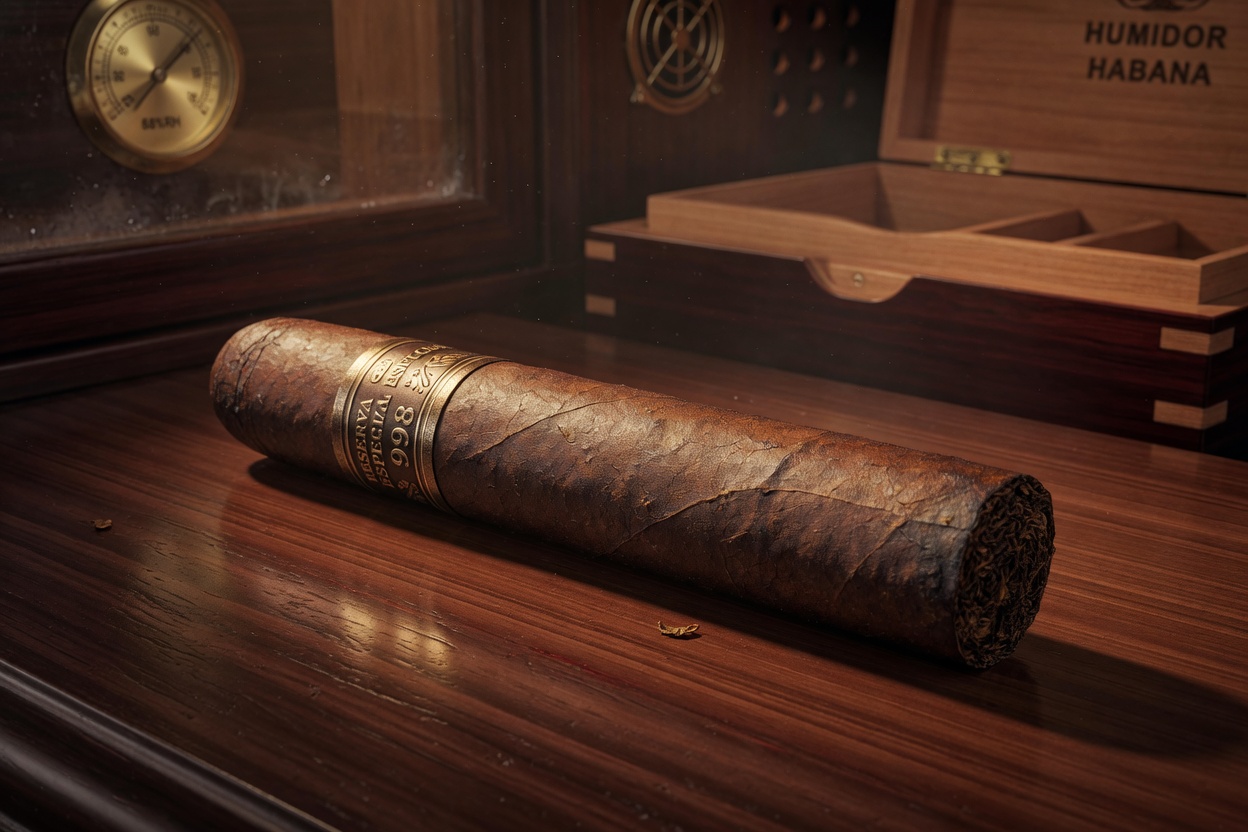
Recommended parameters: separate short-term resting from long-term aging
| Use | Recommended temperature | Recommended relative humidity | Time scale | Flavor and usage goals |
|---|---|---|---|---|
| New stock stabilization / short-term resting | 18–20 °C | 65%–68% RH | 2–8 weeks | Remove uneven moisture caused by transport, reduce closed-packaging odor, retain a fuller oily feel |
| Regular aging | 17–19 °C | 63%–66% RH | 6–24 months | Harshness and edges decline; mid-to-late aromas of wood, nuts, cocoa, dried fruit become more coherent; burn is usually more even |
| Long-term aging | 16–18 °C | 62%–65% RH | 2–8 years | Pursues integration and finesse; intense pepper and fresh herbal notes recede; sweetness, leather, cedar, and aged-wood character surface more readily |
These ranges are not "the lower, the more premium". Below about 60% RH, wrappers crack more easily, draw speed rises, and the aroma turns thin; above 68% RH left unmoved for a long time, cigars become dull, the burn line worsens, and mold risk rises accordingly. As for temperature, 16–20 °C is the practical range for aging finished cigars; near or above 25 °C, especially with high humidity, the risks of egg hatching, mold, and flavor dulling rise markedly.
Easy to remember, but it pushes up both water activity and heat load; over time it makes cigars duller and more prone to mold.
Lower and more stable humidity and energy level, favoring smooth burning, integrated aromas, and headroom for seasonal fluctuation.
Temperature: slower is actually more like aging
One summer in Shanghai I helped a friend organize a humidor kept on top of a bookshelf cabinet: in mid-July the room stayed at 28 °C for three consecutive days, while the humidor still displayed 67% RH. The numbers looked "under control", but the first thing smelled on opening was wet cardboard and a stuffy sour note; the foot of a Robusto in one box felt soft, and it kept going out when lit. The problem was not whether mold appeared within those three days, but that high temperature sped up both moisture migration and reaction rates — a stable reading does not equal a stable state.
A long-term cabinet should keep daily fluctuation within ±1 °C, ideally no more than ±2 °C. Do not mount the temperature sensor flush against the cooling backplate or next to the humidification pack; I habitually place one calibrated digital thermo-hygrometer at the front of the middle shelf and another at the rear of the bottom shelf, recording the highest and lowest values and the number of door openings once a week. If the difference exceeds 2 °C for two consecutive weeks, first deal with cabinet position, sealing, and cooling circulation before discussing a new humidification setup.
Humidity: watch the balance, not just the display
Cigars absorb moisture slowly. A reading that returns to 65% RH two hours after one re-humidification does not mean the cigars have returned to 65% RH; the balance of wrapper, binder, and filler often takes several days. For a new humidor or wooden box, first stabilize with two-way humidity packs at about 65% RH for 7–14 days, then put the cigars in. Do not chase the reading with open distilled water: moisture arrives too fast, the wood and outer leaves soak it up first, while the interior stays dry — the most common result is a display showing 70% RH yet a harsh draw.
If you want a fuller smoke in the short term, set 66%–68% RH; but if the plan is to keep cigars for more than two years, I would lower it to 63%–65% RH. The reason is not superstition about numbers: lower humidity favors smooth burning and leaves headroom for seasonal fluctuation. If a batch of cigars at 65% RH keeps showing dullness, hard lighting, and loose ash, move them separately to 62%–63% RH first and judge only after at least 21 days of rest; dropping three or four percentage points at once easily pulls cracks into the wrapper.
Air circulation: exchange is needed, wind is not
"Ventilation" is most often overdone. Finished cigars need slow air exchange that prevents localized moisture buildup — not a fan blowing directly at the box. Continuous direct airflow dries the side near the air inlet first, causing wrapper curl and inconsistent batches inside the box, and it also carries the aromas of other cigars onto each other.
In practice, a well-sealed humidor does not need to be opened daily. A small wooden cabinet needs only 30–60 seconds of opening every 7–10 days; for a fully loaded electric humidor, swap the box positions between the lower and upper shelves once a month, and check corners, the backplate, and the humidification unit. In cabinets with a circulation fan, the airflow path should be broken up by dividers or boxes so that no wind is felt by hand. When aging in the original box, there is no need to remove the cellophane; it slows exchange slightly but reduces cross-flavoring and mechanical damage. The only exception is products with a strong added flavor, which should be stored separately from traditional blends.
A workable 90-day routine
On day 0, register new cigars by brand, format, and arrival date; check for white fuzzy mold spots, pin-holes, or wrapper cracks. Then place them, still in the original box or cellophane, in a separate area at 65% RH and 18 °C; do not rush to smoke them.
On day 14, check the difference between the two sensors. If it exceeds 3% RH, adjust the humidification pack position or reduce loading density first — do not add water immediately. On day 30, smoke one as a baseline and record ease of lighting, the wet/dry feel of the smoke, harshness across the first, middle, and final thirds, and the burn line. On day 60, move the bottom boxes to the upper-middle level and check whether the cigar feet feel soft. On day 90, smoke another for comparison; if harshness has eased while the main aromas remain clear, the batch can move into the long-term zone at 63%–65% RH. This is far more reliable than relying only on the time judgment of "it has rested for three months".
How flavor changes, and when to stop
0–3 months is mainly recovery and stabilization: dryness, temperature swings, and closed-packaging odor from transport are digested, and the taste is not necessarily more complex. 6–12 months is often the stage where change is most easily perceived: harsh pepper, green, or ammonia notes decline, the smoke rounds out, and aromas no longer fight one another. After two to five years, a good blend may present finer wood, dried fruit, cocoa, and leather notes, with a longer finish; meanwhile, fruit acidity, strong pepper, and fresh vegetal character may also fade. Those who prefer strength may not like this outcome.
That is why I do not treat long-term aging as the standard answer for every cigar. Keep 3–5 cigars aside per batch, set sampling points at 3, 6, 12, and 24 months; when the aroma has become smooth but the identity of the body starts to decline, stop hoarding and put the rest into the "drinking window". Success in aging is not storing time in a box, but opening a cigar at the right time.
Sources
The parameters in this article focus on collection aging of finished cigars, drawing on a 2024 study on oxygen-regulated research of cigar tobacco published in Frontiers in Microbiology, and a 2024 cigar aging metagenomics study published in BMC Microbiology. Both studies point out that temperature, humidity, time, and the air/oxygen environment jointly affect tobacco chemical composition and microbial activity; this article treats them separately from the combustion, mold, and structural risks of finished cigars, and the ranges given are practical recommendations, not a unified production standard. Smoking is harmful to health.