How Do Harmful Components in Tobacco Enter the Bloodstream Through the Nasal Cavity and Respiratory Tract
What you inhale is not just "smoke," but a rapid logistics chain that moves from the nasal cavity and airways to the alveoli, then crosses an ultra-thin membrane into the bloodstream and travels throughout the body via arteries. Understanding this pathway reveals why tobacco-related exposure is never just about "lung damage" but represents **a systemic risk**.
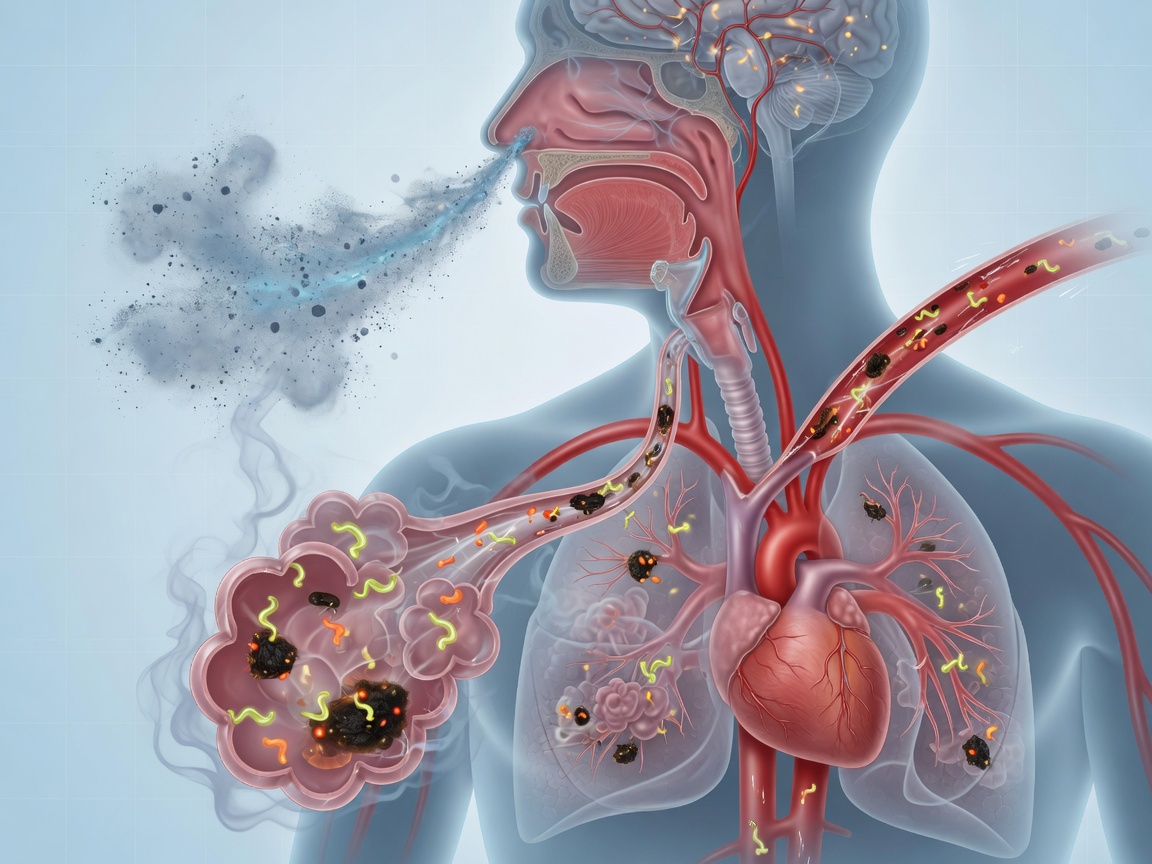
I. First, a Key Question: Does One Puff Stop at the Lungs?
Many people intuitively believe: smoke is "inhaled," so it mainly damages the lungs; nasal discomfort, throat irritation, coughing, and phlegm all seem like "local issues."
From the perspective of absorption and circulation, this is not the case.
The aerosol produced by burning or heating tobacco is a mixture of **gas + particulate matter**. Some components are absorbed in the nasal mucosa, oropharynx, and tracheobronchial surfaces; more components travel all the way to the alveoli—where there is a massive exchange surface and an extremely thin air-blood barrier. Once across this barrier, substances enter the pulmonary circulation, are pumped by the left heart into the systemic circulation, and **within seconds to tens of seconds** can reach the brain, heart, vascular endothelium, and other organs.
A more accurate description is:
The respiratory tract is the "entry and transit station"; the bloodstream is the "nationwide delivery network."
Let's walk through this pathway with an overall route map below.
II. What Is in the Smoke? (First, a Classification)
A single cigarette can produce thousands of chemical compounds when burned; recognized harmful components include nicotine, carbon monoxide, tar-related particulates, irritating aldehydes, various carcinogens (such as certain nitrosamines, polycyclic aromatic hydrocarbons), heavy metals, and radioactive substances. Forpopular science purposes, you don't need to memorize the list; a classification by **physical form + route of entry into the blood** suffices:
|------|---------------|---------|-----------------|
**Key point:** Different components have different "stop stations," but they often converge at the same destination—**the blood and systemic tissues**.
III. Overall Pathway: From "Inhalation" to "Systemic Distribution"
Below is a textual flowchart describing a typical inhalation exposure (primarily smoking; nasal inhalation like snuff has more prominent absorption in the upper airway).
[1] Mouth / Nose inhale aerosol
        │
        ▼
[2] Upper airway (nasal cavity · nasopharynx · oropharynx · larynx)
   · Larger particles more prone to impaction/deposition
   · Rich mucosal vasculature → some nicotine can be absorbed directly
   · Mucociliary system attempts to "clear"
        │
        ▼
[3] Trachea → Bronchial tree → Bronchioles
   · Medium-sized particles deposit along the way
   · Cilia, mucus, cough reflex involved in clearance
   · Irritant gases damage epithelium, trigger inflammation
        │
        ▼
[4] Alveolar region (the "super interface" for gas exchange)
   · Ultrafine particles and gases most easily reach here
   · Alveolar walls are extremely thin, total surface area is enormous
        │
        ▼
[5] Crossing alveolar epithelium → interstitium → capillary endothelium
   (Air-blood barrier, thickness measured in micrometers)
        │
        ▼
[6] Enter pulmonary capillary blood
        │
        ▼
[7] Pulmonary veins → Left atrium → Left ventricle
        │
        ▼
[8] Aorta → Systemic arterial system
   · Brain (nicotine arrives within seconds)
   · Coronary arteries and systemic vascular endothelium
   · Liver, kidneys, reproductive system, immune organs...
        │
        ▼
[9] Distribution · Metabolism · Excretion / or Accumulation and Chronic Damage
   · Nicotine is mainly metabolized in the liver
   · CO occupies hemoglobin, reducing oxygen-carrying capacity
   · Carcinogens can cause damage locally and in distant organs
One-sentence recap:
Inhalation → deposition and absorption along the airway → crossing the alveolar membrane into the blood → pumped by the left heart → arterial delivery throughout the body.
This is the physical and physiological basis for why "inhaling causes systemic harm."
IV. Detailed Pathways: Who Enters the Blood and How?
1. Nicotine: The Fastest "Brain-Delivery Parcel"
Nicotine is readily soluble in water and also lipid-soluble, making it ideal for crossing biological membranes.
Pathway Characteristics:
1. **Upper airway mucosal absorption:** The nasal cavity, oral cavity, and pharynx have rich blood flow in their mucosa. Smokeless tobacco products used nasally (such as snuff) can achieve significant local absorption in the nasal mucosa; during smoking, the oropharyngeal and airway mucosa also participate in absorption.
2. **Efficient alveolar absorption:** During deep inhalation, more nicotine reaches the alveoli. The alveolar surface area is enormous and the barrier is extremely thin, allowing nicotine to rapidly enter the pulmonary capillaries.
3. **Post-absorption destination:** Travels via the pulmonary veins to the left heart, then is ejected into the systemic circulation. Blood delivers nicotine throughout the body, with **arrival at the brain typically taking seconds to about ten seconds** (often described inpopular science as "about 7–10 seconds," varying by individual and inhalation method).
4. **Central effects:** Acts on nicotinic acetylcholine receptors, altering reward and withdrawal pathways—this is a physiological core of addiction.
5. **Metabolism:** Primarily transformed in the liver, with metabolites excreted via the kidneys and other routes; but "metabolized" does not mean "harmless process"—repeated peak-and-trough fluctuations themselves reinforce dependence and cardiovascular stress.
What readers should remember:
Nicotine is not a "flavor molecule that stays in the lungs"; it is **a systemically active substance that rapidly enters the blood and brain**.
Nasal Route vs Deep Lung Route
Nasal Cavity / Upper Airway Dominant
- Typical exposure: snuff, some nasal aerosols
- Nasal mucosa rich in blood vessels, can directly absorb into blood
- Larger particles mostly deposit here
Deep Lung / Alveoli Dominant
- Typical exposure: deep inhalation smoking, deep deposition of most aerosols
- Alveolar surface area is enormous, membrane crossing is extremely fast
- Ultrafine particles and gases more easily reach here
2. Carbon Monoxide: The "Invisible Passenger" That Steals Oxygen Seats
Carbon monoxide (CO) is a typical product of incomplete combustion. It enters the airway as a **gas**, relying not on "particle deposition" but on **diffusion** into the alveolar blood.
Pathway Characteristics:
1. Reaches the alveoli with inhaled air;
2. After diffusing into the blood, it binds with hemoglobin to form carboxyhemoglobin;
3. CO's affinity for hemoglobin is far higher than that of oxygen (commonly described as approximately **200–300 times** greater);
4. The result: the same volume of blood **can carry less oxygen**, leading to relative tissue hypoxia;
5. The heart and brain are sensitive to hypoxia; repeated long-term exposure increases cardiovascular burden.
What readers should remember:
CO's harmful pathway is "clean": **gas → alveoli → blood → hemoglobin occupied → systemic oxygen supply reduced**. It does not need to "corrode lung tissue" to harm the whole body.
3. Particulates and Tar-Related Components: First "Land," Then "Dissolve/React"
The particulate phase of smoke (often associated with the concept of "tar") consists of aerosol particles of varying sizes. Particle size largely determines **where they are most likely to settle**:
Larger particles ──► More prone to "impaction deposition" in the nasal cavity and pharynx
Medium particles ──► Deposit along the bronchi and bronchioles
Ultrafine particles ──► More likely to reach deep into the alveolar region
After deposition, several things may happen:
What readers should remember:
Particles are like "trucks carrying dangerous cargo"—**they first unload at different stations based on size, then release harmful components into tissues and blood**.
4. Irritant Gases and Carcinogens: Surface Attack, Remote Strike Possible
Irritants such as aldehydes directly stimulate the eyes, nose, pharynx, and airways, causing tearing, sneezing, coughing, phlegm, and mucosal congestion—this is the "local war" many people experience first.
At the same time, various known or potential carcinogens can:
Thus, "throat discomfort" is only part of the warning; **the real danger is the systemic and multi-organ risk accumulated through repeated exposure**.
V. Nasal Route vs. Deep Lung Route: What's the Difference?
|------------|--------------------------------------|------------------------------|
A common misconception is: "If I use nasal inhalation or smokeless methods, it bypasses the lungs, so it's safer."
A more accurate understanding is:
VI. After Entering the Blood: Why Is It "Systemic Harm"?
Entering the bloodstream is just the beginning. The systemic circulation acts like a delivery network, sending "goods" to nearly all tissues.
1. Cardiovascular and Cerebrovascular System
Together, these constitute the background mechanisms for increased risk of coronary heart disease, stroke, and other conditions.
2. Brain and Addiction Circuitry
Nicotine rapidly enters the brain, repeatedly reinforcing the "want another puff" circuit; withdrawal brings irritability, decreased concentration, and cravings, driving the next inhalation—**exposure becomes self-sustaining**.
3. Respiratory and Immune Systems
Long-term airway inflammation, damaged cilia, altered susceptibility to infection; the immune system is caught in a tug-of-war between chronic activation and dysfunction.
4. Other Organs
Reproductive health, wound healing, skin aging, and some tumor risks are all linked to long-term systemic exposure to tobacco smoke components. You don't need to memorize every organ; just establish a framework:
Enter blood → distribute to target organs → endothelial damage / hypoxia / inflammation / DNA damage / receptor activation
                 ↓
        Acute symptoms + chronic disease risk accumulation
"Systemic harm" is not rhetoric; it is an anatomical inevitability of the circulation.
VII. Time Scale: How Fast? How Persistent?
|------------|------------------------|
The dose-response relationship is important: **not every exposure causes immediate illness, but each exposure adds a charge to the risk account**.
VIII. Common Misconceptions Clarified
Myth 1: "I exhale the smoke / don't inhale deeply, so I absorb very little."
The upper airway mucosa can also absorb nicotine; sidestream smoke and oral residue also contribute to exposure. Deep inhalation often increases lung absorption, but not deep inhaling ≠ safe.
Myth 2: "A filter blocks harmful substances."
Filters can alter particle size distribution and inhalation patterns, but they cannot eliminate gas components (such as CO) and large amounts of harmful substances; they also cannot "turn off" the entry route into the blood.
Myth 3: "Only the lungs are damaged; the liver, kidneys, and heart are fine."
Entry into the blood means systemic distribution. The lungs are one portal, not the only victim.
Myth 4: "Nasal discomfort is just allergies or a cold."
Smoking-related irritation can cause rhinitis-like symptoms; while it should be differentiated from true allergic rhinitis, the "nasal symptoms" themselves indicate that the upper airway is already under chemical assault.
Myth 5: "I don't inhale secondhand smoke, so it doesn't affect me."
Environmental tobacco smoke also enters others' bodies through the respiratory tract, following the same "inhalation—absorption—entry into blood" framework.
IX. A Memory Card: Put the Pathway in Your Mind
Gases (e.g., CO)     ──diffusion──► alveoli ──► blood (competes for hemoglobin)
Nicotine             ──mucosal/alveolar absorption──► blood ──seconds──► brain and body
Particulates/tar     ──size-based deposition──► local inflammation + dissolution/entry into blood
Irritants/carcinogens──surface damage + absorption/metabolism──► local and distant organ risk

Common highway:
Respiratory tract entry → air-blood barrier → pulmonary veins → left heart → arteries → whole body
Why does inhalation cause systemic harm?
Because the human body designed the lungs as an efficient gas exchanger—it treats oxygen the same way it treats many smoke components. Once this efficient exchange is exploited by harmful substances, systemic delivery becomes inevitable.
X. Summary and Action Guidance
1. Tobacco smoke is a complex mixture of gas and particulate phases; different components have different "stop stations" in the nasal cavity, airways, and alveoli, but multiple routes lead to the blood.
2. Nicotine rapidly enters the blood and brain; carbon monoxide impairs oxygen transport; particulates and carcinogens bring risks of local and systemic inflammation, oxidation, and DNA damage.
3. The nasal cavity is not a "safe bypass"; it is another door through which absorption can occur.
4. Understanding the pathway is meant to dispel misconceptions such as "only the lungs are harmed," "filters make it safe," or "my body can handle it," and to base decisions on physiological facts.
5. **Reducing and ultimately stopping inhaled tobacco/nicotine exposure** is the most fundamental way to cut off this harmful logistics chain. If dependence exists, seek professional smoking cessation clinics, behaviorally supported guidance, and approved cessation interventions, rather than relying on unproven remedies.
Disclaimer
This article is a health education piece intended to help the public understand the general pathways and mechanisms by which harmful tobacco components enter the bloodstream through the nasal cavity and respiratory tract. It cannot replace individualized diagnosis and treatment by a licensed physician. For specific symptom evaluation, smoking cessation plan selection, and medication, please follow local guidelines and consult professional medical personnel. The timeframes and quantities mentioned are typical educational descriptions descriptions and may vary due to individual and exposure condition differences.
(End)
Note: Inhalation method, dose, and individual differences affect actual absorption rate and extent.