Technical Data Comparison of Major Chemical Components of Different Tobacco Varieties
Reducing tobacco leaves to just "strong" or "sweet" oversimplifies the issue. When I compiled public chemical data of flue-cured, burley, and oriental (aromatic) tobaccos in August 2026, the metric I adopted was **the mass fraction of cured and aged tobacco leaves on a dry basis**; it is not a finished cigarette formula, nor can it be directly extrapolated to consumer inhalation. Variety, origin, stalk position, nitrogen application, and curing curve can all cause individual batch data to fall outside the table ranges. Therefore, these values are suitable as a starting point for leaf selection, incoming material comparison, and process diagnosis, not as a rigid acceptance line.
First, Look at the Data: The "Chemical Underpinnings" of Three Basic Leaf Types
| Parameter (Dry Basis) | Flue-Cured / Virginia (Heat-Cured) | Burley (Air-Cured) | Oriental / Sun-Cured | Main Implications for Smoke and Combustion |
|---|---|---|---|---|
| Nicotine / Total Alkaloids | 1.5%–3.0% | 2.0%–5.0% | 1.0%–2.0% | Determines potential nicotine supply; free-base ratio is also influenced by smoke pH. |
| Total Sugars (Often Measured as Reducing Sugars) | Approx. 20%–25% | 0.2%–2.0% | Approx. 10%–14% | Pyrolysis generates carbonyl compounds, organic acids, and furan precursors; "higher sugar" does not mean "better." |
| Organic Acids (Total Carboxylic Acids) | 2.5%–4.0% | 1.5%–3.0% | 2.0%–4.5% | Form salts with nicotine, affecting acid-base balance; malic, citric, and oxalic acids are often the major components. |
| Polyphenols | 3.0%–5.0% | 3.0%–4.0% | 3.0%–5.0% | Chlorogenic acid, rutin, etc. are important precursors for color and aroma transformation; oxidation degree alters aroma and irritation. |
| Ash | 10%–13% | 20%–26% | 12%–16% | Mineral composition affects burn rate and ash characteristics; high ash does not necessarily mean easier ignition. |
The typical ranges of sugars, nicotine, organic acids, and polyphenols for flue-cured, burley, and oriental tobaccos in the table come from cured leaf levels in tobacco chemistry reviews; field measurements from Henan flue-cured tobacco regions also show organic acids 120.01–216.01 mg/g, total alkaloids 18.85–29.97 mg/g, and polyphenols 16.85–27.92 mg/g. This reminds me that even among flue-cured tobaccos, origin differences can make "typical values" lose their singular answer.
Why Curing Methods Stretch the Differences
The key to flue-cured tobacco is that the yellowing stage still retains a window for converting starch to sugar, followed by relatively rapid drying that terminates enzymatic consumption, resulting in high leaf sugar. In burley, the longer air-curing process consumes a large amount of sugar, leaving higher nitrogenous components and lower native sugar; public literature often describes its cured leaf sugar as approaching 0 to 0.2%, which is not contradictory to the broader typical range of "0.2%–2.0%." Oriental tobacco has small leaves, a prominent sun-cured aroma style, and sugars and nicotine are generally moderate to low.
What I value more is the ratio, not any isolated percentage. For example, a batch of flue-cured tobacco with total sugar 22% and nicotine 2.0% has a sugar/nicotine ratio of about 11; another batch of burley with total sugar 0.5% and nicotine 3.5% has a ratio of only about 0.14. These two cannot be explained away by "the former is sweet, the latter is strong": the former has more thermally degradable carbohydrate substrates, while the latter's nicotine potential and alkaline smoke background require separate evaluation.
From the Leaf to the Combustion Zone: "Composition" Cannot Be Equated to "Smoke Yield"
The area ahead of the combustion cone is not a single reactor. During puffing, tobacco undergoes drying, pyrolysis, oxidation, and distillation; temperature, oxygen supply, cigarette paper, ventilation holes, and puffing regime all alter the products. Therefore, leaf content can only explain trends, not be directly converted to milligrams of a given substance in a specific puff.
The relationship of sugar is the clearest, yet also the most frequently misinterpreted. During pyrolysis, sugars can form acetaldehyde, formaldehyde, acrolein, acetone, furfural, and various organic acids. A published review summarizing sugar addition studies showed that adding 12% sugar to a burley reference cigarette increased formaldehyde, acetaldehyde, acetone, and acrolein in mainstream smoke, with the magnitude varying by sugar type and tobacco. This result indicates that "sugar is a carbonyl precursor," not that natural sugar content has a fixed linear relationship with any smoke component.
Nicotine must be broken down into "total amount" and "form." Nicotine in tobacco leaves mostly exists as salts bound with organic acids; heating and the smoke acid-base environment alter the free-base ratio. The commonly higher smoke pH of burley (cited in public literature as approximately 7.2–8.0) compared to the typically lower pH of flue-cured and oriental tobaccos (approximately 5.8–6.2) changes the protonation state of nicotine in smoke. This discussion concerns physicochemical behavior and in no way represents the safety of any tobacco product; tobacco smoke contains numerous harmful and addictive substances.
The roles of polyphenols and organic acids are also not unidirectional. Chlorogenic acid, rutin, and other polyphenols participate in oxidation, cleavage, and aroma precursor changes during curing and aging; organic acids influence nicotine salt formation, acidity, and sensory smoothness. Once they enter the high-temperature zone, they continue to undergo cleavage, condensation, or oxidation, so one cannot directly equate "high polyphenols in the leaf" with "more aromatic smoke" or "lower risk."
A Reproducible Comparison Protocol: Locking Subjective Impressions Back to Data
The following is an **example laboratory protocol**, not a field test experience I personally conducted; it clearly describes the steps I consider most error-prone. Assume that on July 15, 2026, in a routine tobacco quality inspection laboratory, three independent batches of each of the three aged leaf types were taken:
- Random sampling from mid-stalk leaves of each batch, removing the midrib and grinding; moisture measured at 105°C, then converted to dry basis. The most common problem is directly comparing "as-is percentages" — a moisture difference of around 10% is enough to reverse small differences.
- Sieving to the same particle size: nicotine determined by continuous flow analysis or validated chromatography; total/reducing sugars by continuous flow method; organic acids and polyphenols by HPLC. Insert one duplicate and one quality control sample every ten samples; when the relative deviation of duplicates exceeds the laboratory's established limits, first check grinding uniformity and extraction time, not pick a "good-looking" result.
- Plot the results in four columns simultaneously: nicotine, sugar, total organic acids, polyphenols, and calculate the sugar/nicotine ratio. To study smoke, cigarette construction, conditioning, and puffing regime must be fixed, and smoke pH, total particulate matter, nicotine, and carbonyl compounds must be measured independently; leaf analysis and smoke analysis must never be mixed in the same table.
My assessment is: flue-cured tobacco is suitable for providing a higher-sugar chemical backbone, burley provides low sugar, higher nicotine, and a different acid-base background, and oriental tobacco is better suited to complement from aroma precursors and style. This assessment is meaningful only when sample specifications, processing, and testing methods are all consistent. When faced with a blend formula, the most important question to ask is not "which leaf is best" but "what moisture basis, what stalk position, what curing and aging was this batch measured under."
References and Boundaries
- *Studies of Pyrolysis* lists typical ranges of sugars, nicotine, polyphenols, organic acids, and ash for three types of cured tobacco.
- *Influences of different curing methods on chemical compositions in different types of tobaccos* (2021) demonstrates that curing methods significantly alter sugars, nicotine, and polyphenols.
- 《Comparison of Major Secondary Metabolites in Flue-Cured Tobacco Leaves from Different Henan Tobacco Regions》(2020) provides regional measured ranges of organic acids, total alkaloids, and polyphenols in flue-cured tobacco.
- *Scientific assessment of the use of sugars as cigarette tobacco ingredients* (2012) summarizes research on sugars and smoke carbonyl compounds, and notes that burley's native sugar can be extremely low.
This article is only an information compilation of raw material chemistry and combustion mechanisms; it does not constitute product design, consumption advice, or health advice. All tobacco products carry health risks; comparing chemical data does not diminish this fact.
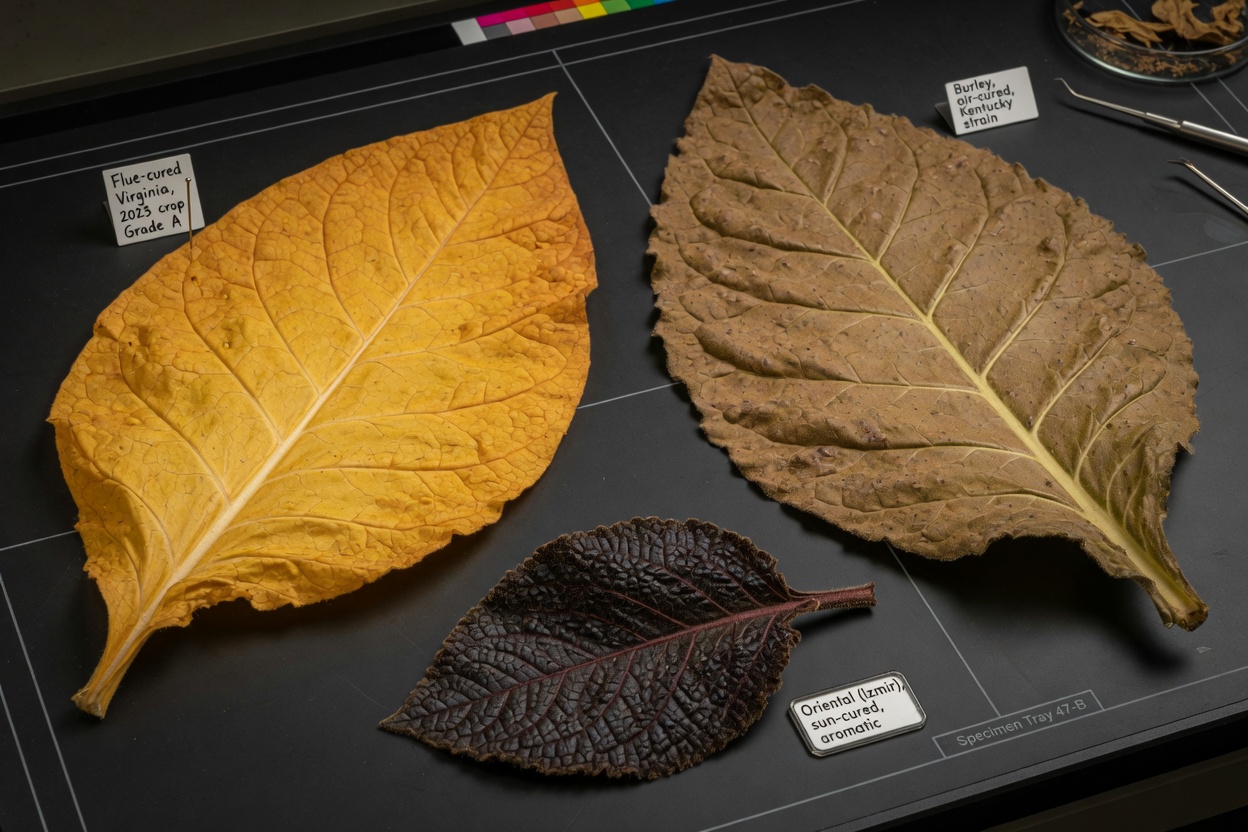
Flue-Cured / Virginia
Heat-cured, high sugar content (approx. 20%–25%), moderate nicotine (1.5%–3.0%). Provides a higher-sugar chemical backbone with more thermally degradable carbohydrate substrates.
Burley
Air-cured, low sugar (0.2%–2.0%), higher nicotine (2.0%–5.0%). Higher nitrogenous components, alkaline smoke background (pH 7.2–8.0), different acid-base balance.
Oriental / Sun-Cured
Sun-cured, small leaves, prominent aroma style. Sugar approx. 10%–14%, nicotine 1.0%–2.0%. Better suited for aroma precursor and style complementation.