Key Humidity and Time Parameters in Tobacco Redrying Process and Their Impact on Subsequent Cutting and Combustion
Having worked on the front lines of tobacco production for twenty years, I have always believed that if toasting gives tobacco its "soul," then redrying gives it its "backbone." Many young technicians think redrying is simply "spray some water and wait a while," but in my view, this is precisely the "critical juncture" that determines the ultimate success or failure of an entire batch of tobacco.
The "Lifeline" of Fibers: The Battle Between Humidity and Elasticity
### The "Lifeline" of Fibers: The Battle Between Humidity and Elasticity
The essence of redrying is to use moisture to penetrate the tobacco leaf cell walls, changing its physical properties from a dry, brittle state to one with a certain degree of ductility. In my experience, the core goal of redrying is not simply "replenishing water," but to achieve a precise **moisture balance point**.
Based on my years of on-site measurements on the production floor, for most high-quality tobacco leaves, the moisture content after redrying should be strictly controlled within the very narrow range of **13.5% to 14.8%**.
This range may seem broad, but it is extremely delicate. I remember one hot summer day in 2015, when the workshop air conditioning system failed, and the ambient relative humidity (RH) suddenly surged from the normal 65% to 85%, causing moisture compensation in the redrying room to accelerate too quickly. In just 20 minutes, the moisture content of that batch of tobacco leaves jumped from the expected 14% to 16%. The result was obvious: when cutting, the tobacco strands that should have been neat and uniform turned into a pile of crumpled, rotten leaves, with extremely poor strand shape and even a large amount of "knife sticking."
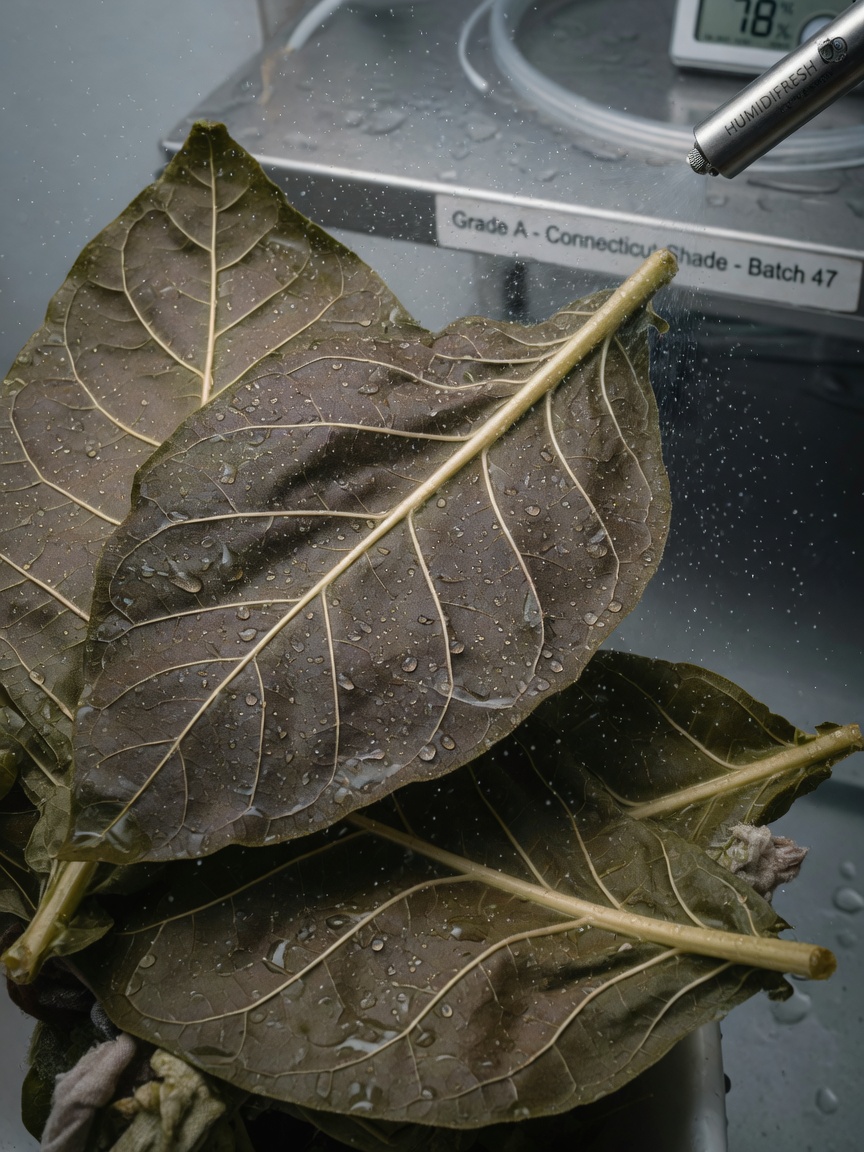
The core goal of redrying is to achieve a precise moisture balance point, not just simple water replenishment.
Cutting quality is extremely sensitive to moisture content; both under-drying and over-drying cause severe defects.
Moisture distribution uniformity directly affects combustion stability and determines smoke quality.
📊 Key Parameters
Cutting Quality: The "Critical Point" of Breakage Rate and Strand Shape
### Cutting Quality: The "Critical Point" of Breakage Rate and Strand Shape
The impact of redrying parameters on cutting is immediate. The cutting process is essentially a shear stress test on fibers.
• **Insufficient moisture (< 13.0%)**: This is the most dangerous state. The fibers are in a "brittle phase" with extremely low toughness. Under the blade pressure of the cutting machine, the fibers are not smoothly cut but shatter. I have calculated that for every 0.5% decrease in moisture content, the fines percentage increases exponentially. In one incident, because the redrying time was shortened by 15 minutes, the fines content of that batch doubled, and the entire batch had to be downgraded.
• **Excess moisture (> 15.5%)**: This causes the fibers to become overly softened, losing their proper structural support. The cut tobacco strands not only lack adequate roundness but, more critically, are prone to physical compression and deformation during subsequent conveying, forming "clumps" — a nightmare for automated packaging lines.
Combustion Performance: How Moisture Determines the "Character" of Smoke
### Combustion Performance: How Moisture Determines the "Character" of Smoke
Many technicians easily overlook the impact of redrying on combustion, which is a very unprofessional mistake. Moisture is not just about form; it is about the stability of energy release.
An ideal redrying state ensures that during combustion, the evaporation rate of moisture and the oxidation rate of tobacco organics achieve a dynamic balance. If redrying is uneven, it creates a "dry-wet gradient" inside the tobacco. During combustion, areas with high moisture content inhibit the combustion rate, forming "cold spots," while areas with low moisture trigger "hot spots," causing intense and unstable combustion, resulting in excessive ash and irritating smoke.
My personal experience is: **Dwell time is often more difficult to control than moisture value alone.** Moisture is the "quantity," while time is the "quality." Moisture penetration into the fibers takes time. If you pursue only surface moisture targets while shortening the dwell time, you end up with a "wet surface, dry core" illusion, which manifests as extremely unstable combustion behavior in burn tests.
Dry vs Wet: Impact of Two Extremes on Cutting
Insufficient moisture (< 13.0%)
Fibers become brittle, shatter during cutting, fines rate increases exponentially
Excess moisture (> 15.5%)
Fibers over-softened, inadequate strand roundness, prone to clumping during conveying
Expert Advice: Don't Blindly Trust Automation — Learn to "Sense"
### Expert Advice: Don't Blindly Trust Automation — Learn to "Sense"
Today's workshops are full of automated humidity sensors and PLC control systems, but I must remind everyone: **Sensors can only tell you "what it is now"; they cannot tell you "how the tobacco feels."**
I have always maintained a habit: on the basis of automated control, manual "touch inspection" must be combined. I regularly take samples, gently pinch the tobacco strands, and feel the rebound resistance and fiber toughness. This kind of physical-intuition-based judgment can often detect potential trend risks before the sensors alarm.
For the redrying process, my core view is: **Better slow and thorough than fast and superficial.** Steady, uniform, deep moisture penetration is always more important than achieving surface moisture targets at the expense of efficiency.
This article is a technical experience sharing, aiming to discuss process details, not a standardized operating procedure.
*This article is a technical experience sharing, aiming to discuss process details, not a standardized operating procedure.