What Are the Best High-Margin Monetization Models for Tobacco Health Content?
People who create tobacco and smoking cessation health content most commonly fall into a trap — not "running out of things to write," but treating traffic as an asset while turning monetization into manual labor.
I started working seriously on this track in the second half of 2022: first writing educational content about "smoking and periodontal disease, halitosis, oral precancerous lesions," then gradually moving into consulting on cessation pathways, nicotine replacement, and nose-inhalation auxiliary products. My account isn't huge — by March 2023 my public WeChat account had about 12,000 followers, and by June 2024 a single video post peaked at 180,000 views — but because the topic selection is vertical, conversion rates are generally a cut above general health accounts. Over three years I've run through advertising, knowledge payment, one-on-one consulting, product promotion, and brand partnerships. What follows isn't a checklist-styleeducational content, but an honest assessment using gross margin, replicability, compliance risk, and time cost as the four metrics to clarify what actually makes money in this track.
Let's First Define "High Margin"
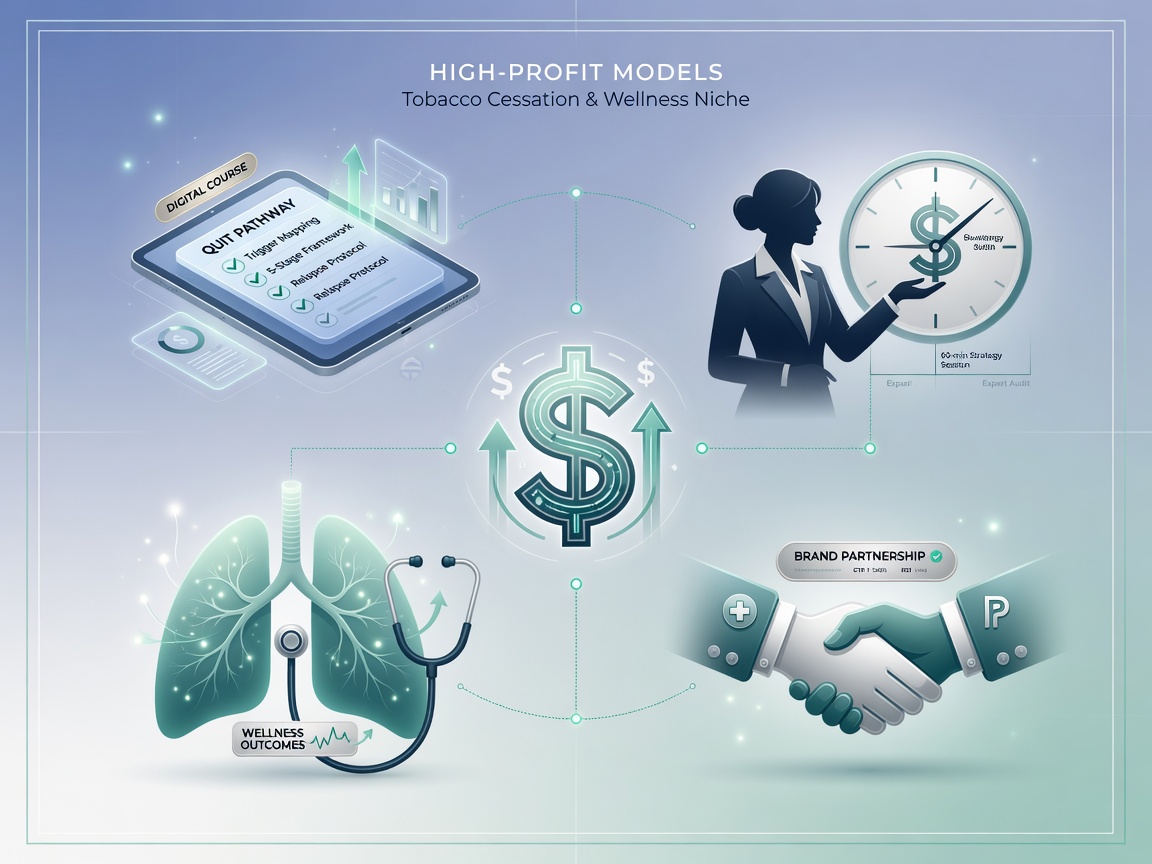
Four core monetization paths for tobacco health content
Many people equate "high margin" with "high unit price." That's wrong.
In my view, high margin = (revenue − direct fulfillment costs) / revenue, and you also have to deduct hidden costs: customer service time, refund rates, compliance review, and the opportunity cost of having your account restricted.
Here are three real comparisons (2023–2025, individual and small-team experience range, not an industry-wide standard):
Model
Typical Unit Price
Direct Cost Ratio
Rough Gross Margin
Main Pitfalls
Info flow/soft ads
3,000–30,000 RMB/article
10%–25% (production + tax)
70%–90%
Platform rules, tobacco-related review
Knowledge payment (recorded courses)
99–999 RMB
15%–35% (editing + platform cut)
65%–85%
Refunds, completion rate, content homogenization
1v1 consulting
299–1,999 RMB/session
5%–15% (time is nearly all the cost)
85%–95%
Not scalable, liability boundaries
Product promotion (drop-ship/distribution)
Commission 15–80 RMB/order
Nearly zero inventory, but heavy after-sales
Commission is gross margin, but **net profit often eaten by after-sales**
Numbers can fluctuate, but the structure is basically stable: consulting and knowledge products have the highest gross margins; advertising has the fastest cash flow; product promotion looks lively but net profit is often the ugliest; brand partnerships are best discussed after you have "a seat at the table."
The industry side confirms this: in content entrepreneurship, consulting/coaching, courses, and advertising sponsorships have long been the most profitable legs for creators; health and wellness affiliate marketing commissions are commonly seen around 8%–25%, which looks considerable, but with long conversion chains and many customer complaints, actual take-home is far lower than the percentage on the table. The domestic influencer economy has long moved past "relying only on ads" — it's advertising, e-commerce, and knowledge payment running in parallel — but the problem is that tobacco health has one more compliance wall than beauty and digital products.
1. Advertising: High Margins, But "Acceptable Orders" Are Very Selective in the Tobacco Health Track
Profit Characteristics
Advertising is essentially selling attention. You don't need inventory, you don't need after-sales service — once a soft article or short video spoken endorsement is done, the money is basically profit. In August 2023, I took on arich-media soft ad for an oral care brand, quoted 8,000 RMB (reading volume about 21,000 at the time), outsourced layout cost 300, taxes assessed as an individual business, net take-home was roughly a bit over 70%.
Real Operations and Pitfalls
In November 2023, a brand selling "lung-cleansing tea" contacted me with a budget of 12,000 RMB, asking me to write "helps smokers detox." I asked them for evidence of efficacy; they only sent me screenshots ofWeChat Moments posts. I turned it down. Not because I'm sanctimonious — it's because once tobacco-related health content steps on "efficacy claims," platform complaints and industrial & commercial risks will directly hit the creator.
Domestic regulation of traditional tobacco and e-cigarette advertising and online sales is extremely strict (e-cigarette online advertising and sales have long had clear bans, with subsequent enforcement tightening). The result:
What you can accept is mostly **oral care packages, health checkups, smoking cessation clinics, exercise rehabilitation, insuranceeducational content** and other "peripheral health" brands;
What you cannot touch is any wording that implies "this product equals medical smoking cessation efficacy."
My view: Advertising is suitable as a cash flow patch, not as the main engine for a tobacco health account. The reason is very practical — the pool of acceptable brands is small, bargaining power is in their hands, and once you reject a non-compliant order, monthly income takes a hit. No matter how high the margin, if order volume is unstable, the annual profit curve will shake badly.
Let's First Define \"High Margin\"
Many people equate \"high margin\" with \"high unit price.\" That's wrong.
In my view, high margin = (revenue − direct fulfillment costs) / revenue, and you also have to deduct hidden costs: customer service time, refund rates, compliance review, and the opportunity cost of having your account restricted.
Here are three real comparisons (2023–2025, individual and small-team experience range, not an industry-wide standard):
Model
Typical Unit Price
Direct Cost Ratio
Rough Gross Margin
Main Pitfalls
Info flow/soft ads
3,000–30,000 RMB/article
10%–25% (production + tax)
70%–90%
Platform rules, tobacco-related review
Knowledge payment (recorded courses)
99–999 RMB
15%–35% (editing + platform cut)
65%–85%
Refunds, completion rate, content homogenization
1v1 consulting
299–1,999 RMB/session
5%–15% (time is nearly all the cost)
85%–95%
Not scalable, liability boundaries
Product promotion (drop-ship/distribution)
Commission 15–80 RMB/order
Nearly zero inventory, but heavy after-sales
Commission is gross margin, but **net profit often eaten by after-sales**
Numbers can fluctuate, but the structure is basically stable: consulting and knowledge products have the highest gross margins; advertising has the fastest cash flow; product promotion looks lively but net profit is often the ugliest; brand partnerships are best discussed after you have \"a seat at the table.\"
The industry side confirms this: in content entrepreneurship, consulting/coaching, courses, and advertising sponsorships have long been the most profitable legs for creators; health and wellness affiliate marketing commissions are commonly seen around 8%–25%, which looks considerable, but with long conversion chains and many customer complaints, actual take-home is far lower than the percentage on the table. The domestic influencer economy has long moved past \"relying only on ads\" — it's advertising, e-commerce, and knowledge payment running in parallel — but the problem is that tobacco health has one more compliance wall than beauty and digital products.
---\n\n## 1. Advertising: High Margins, But the Tobacco Health Track Has Very Few "Acceptable Orders"\n\n### Profit Characteristics\n\nAdvertising is basically selling attention. You don't need inventory, no after-sales service — once a soft article or short video spoken endorsement is done, the money is basically profit. In August 2023, I took on arich-media soft ad for an oral care brand, quoted 8,000 RMB (reading about 21,000 at the time), outsourced layout cost 300, taxes as individual business, net take-home roughly a bit over 70%.\n\n### Real Operations and Pitfalls\n\nIn November 2023, a brand selling "lung-cleansing tea" contacted me with a budget of 12,000, asking me to write "helps smokers detox." I asked for efficacy evidence — they only sent screenshots ofWeChat Moments posts. I turned it down. Not out of sanctimony — because once tobacco health content steps on "efficacy claims," platform complaints and industrial & commercial risks hit the creator directly.\n\nDomestic regulation of traditional tobacco and e-cigarette advertising and online sales is extremely strict (e-cigarette online ads and sales have long had clear bans, with subsequent enforcement tightening). The result:\n\n- What you can accept: mostly oral care packages, health checkups, cessation clinics, exercise rehab, insuranceeducational content and other "peripheral health" brands;\n- What you can't touch: any wording implying "this product equals medical cessation efficacy."\n\nMy view: Advertising is suitable as a cash flow patch, not the main engine for a tobacco health account. The pool of acceptable brands is small, bargaining power is in their hands, and one rejected non-compliant order leaves a hole in monthly income. High margin doesn't help if volume is unstable — the annual profit curve shakes too much.
2. Knowledge Payment: The Best Path to "Productize Lessons Learned"
Profit Characteristics
The marginal cost of recorded courses/e-books/membership is near zero. Produce once, sell 100 or 1,000 — fulfillment costs nearly the same. Platform cuts (commonly ~10%–30% depending on channel) and refunds are the main deductions.
What I Actually Did
Jan–Feb 2024: I took the top 47 private-message questions from the past year and condensed them into a mini-course "Smoker's Oral Self-Check & Pre-Cessation 30-Day Action Checklist":
Price: **199 RMB**
Format: 12 audio lessons + PDF checklist + 1 community Q&A (limited time)
Promotion: near-zero paid, usingWeChat official account menu & video pins
Rough: ~17,000 RMB revenue, ~2,200 direct costs + platform fees, **gross margin easily over 70%**
The problem: completion rate ~31%. Some only listened to lesson 1 "Why teeth turn yellow." In April 2024 I added a "checklist + weekly reminder email," completion climbed to just over 40% — still showing: payment ≠ being helped; you're selling certainty, users buy peace of mind.
vs General Health Courses
Xinhua also reported "health anchor training" chaos — organizations selling "traffic courses" for thousands filled with scripts and sales tricks. Tobacco health following the same path dies faster — the audience is anxious and skeptical, one exaggerated claim and private-domain trust hits zero.
My view: Knowledge payment is the highest-priority high-margin model in this track, but the product must be extremely narrow and actionable. Don't do "Quit Smoking Encyclopedia 99 Lectures"; do "How to Handle Oral Ulcers in the First 2 Weeks of Quitting" — something usable tonight. Narrowness drives repurchase and the next SKU.
3. Consulting: The Ceiling of Gross Margin, Also a Time Grinder
Profit Characteristics
A structured 60–90 min consulting session, priced 399–1,999 RMB is common; with medical background or offline resource coordination, can reach 1,500+. Cost is almost entirely your time + a solid disclaimer. Gross margin often reaches ~90%.
A Session That Woke Me Up
May 2024: A Dongguan foreign trade professional (male, 38, 16-year smoker) paid 699 RMB for a "cessation start consultation." Scheduled 60 min Zoom. At minute 15 he mentioned chest pain and blood-tinged phlegm, asking me to "determine if it's lung cancer."
I immediately stopped the "solution discussion," told him to see a respiratory or thoracic surgeon within 48 hrs, pivoted to: how to talk to family, how to track symptoms, how to register at a cessation clinic. Later it turned out to be inflammation-related — false alarm. But that night I revised the agreement:
1. Clearly state: No diagnosis, no prescription, no substitute for medical care;
Time cost is real: 1 effective consulting hour + prep +review often totals 2.5 hrs. At 699 RMB, hourly rate is decent. But over 6 sessions/week and content updates stop entirely.
My view: Consulting is the highest-margin model and best content topic feeder, but must be deliberately limited. My approach: 8–12 slots/month, stop when full. Consulting is not a scaling engine — it's a pricing anchor + trust dagger + course material mine.
4. Product Promotion: GMV Looks Good, Net Profit Often Looks Bad
Profit Characteristics
Two completely different models:
1. Distribution/affiliate: Commission on sales, no inventory, looks good on surface;
2. Own brand/white-label: Higher margin but supply chain, QC, after-sales &Advertising Law risks.
Health affiliate commissions overseas ~8%–15%, some categories higher. In China, oral care, cessation aids, etc. — commissions range from few yuan to tens. Problem: commission ≠ your net profit.
A Specific Reckoning
Sep 2024: Tested an oral care kit (~168 RMB, distribution model) on video platform, commission 28 RMB/order. Two shorts cumulatively ~21,000 RMB GMV, 120+ orders. Looks good.
What actually happened:
7 people claimed "still have bad breath," demanded return/refund "explanations";
2 posted logistics damage photos, I spent 3 evenings coordinating;
Platform & brand passed the buck, I covered 2 orders' shipping (46 RMB);
Made a remedial "correct usage" video, using a slot meant for deepeducational content.
Final: after-sales time deducted from commission, effective hourly rate dropped below writing a 3,000-word article with a course link.
If involving nose-inhalation cessation devices or nicotine products, risks compound: efficacy claims, minor protection, medical device advertising.
My view: Do product promotion only for products you can vouch for by name, as a fulfillment tool for courses/consulting, not the main exit. GMV-as-KPI in this track = working for customer complaints.
5. Brand Partnerships: Medium-High Margin, But a "Status Game"
Profit Characteristics
Deeper than single soft ads: quarterly advisory, jointeducational content, offline event co-hosting, content co-creation. Amounts from 10K to six figures. Gross margin lower than pure ads (more revision rounds, slower legal), but per-client value high.
One That Fell Through and One That Worked
Dec 2023: A regional dental chain wanted "one post/week for 3 months, package 24,000 RMB." Each post required pushing dental implantinstallment plan at the end. Workload: topic meetings + filming + 2 revisions/week ≈ half a day. Daily rate compressed to part-time filming level. It fell through.
Oct 2024: A health checkup brand paid 46,000 RMB for 4 pieces of "lung & oral exam interpretation for smokers" + 1 internal training. Their legal reviewed scripts, I retained veto on medical statements. Training day: 3 hours explaining "why you can't say teeth cleaning cures smokers' periodontal disease." Smooth, clean payment.
Difference: The former bought a loudspeaker, the latter bought judgment. What you're really worth is not camera presence — it's the ability to draw red lines in front of profit.
My view: Brand partnerships suit only after 10K+ followers and established consulting/courseclosed loop. Too early and you get aesthetically kidnapped, content turns to soft ads, private-domain trust declines, all high-margin models take a hit.
Reference revenue structure (personal account, few-ten to few-hundred-thousand annual):
Knowledge payment 40%–50%
Consulting 25%–35%
Advertising + Brand 15%–25%
Product promotion ≤ 10%
This isn't chicken-soup ratio — it's high-margin products feed content → content feeds trust → trust sells high-margin loop. Let product promotion share get too high and yourcustomer service identity crushes your expert identity.
Compliance Is Part of Margin, Not an Appendix
In tobacco health, compliance directly enters the P&L:
Don't promise "quit in X days" or "cure addiction";
Don't write food/daily chemical/devices as medicine;
Extremely restrained with e-cigarette/novel tobacco expressions; prioritize **harm & medical pathways**;
Add **medical disclaimers & referral guidance** to consulting and courses.
2024: A note on "gum bleeding after quitting smoking." Someone posted a folk remedy in comments. I pinned: "Stop unsubstantiated remedies; if bleeding persists see a periodontist." That note later generated 11 consulting conversions — cleaner than any "magic product recommendation."
What you save isn't face — it's the risk reserve that could wipe out a year's profit.
Practical Route: If You Want to Start Now
(Assuming 3–4 stable content outputs/week):
Weeks 1–4: Content only, no monetization. Lock topics: visible oral damage, cessation timeline, household secondhand smoke, how to read checkup reports. Goal: 20 pieces of "searchable, bookmarked" assets.
Weeks 5–8: Usehigh-frequency private-message questions → 19.9–49 RMB checklist (PDF). Testing willingness to pay, not making money. 30 sold or 2 sold — both useful data.
Weeks 9–16: Iterate to ~199 RMB mini-course, open 4 slots/month for trial-price consulting. Record sessions (with consent) → feed into course V2.
Month 4+: Only then discuss ads & brand deals. Product promotion stays last, ≤ 2 products.
My Conclusion (No Beating Around)
The best high-margin models for tobacco health content are not "blowing up with sales" or "taking every ad," but:
> Tool-type knowledge payment for scalable high margins, limited consulting for ceiling margins & trust, advertising/brand partnerships for cash &endorsement, product promotion only as a verified fulfillment supplement.
If your account is still early, remember just one sentence:
Sell "executable certainty" first, then sell "products."
The margin on certainty will always be higher than that bottle on the shelf claiming to "cleanse your lungs" — and you'll sleep better.